HYROX Stations in Order: All 8 Stations + the Race Format
Updated October 6th, 2026 · Verified against the official Season 26/27 rulebooks · By Geoffrey - Technology & Operations at Fit Viz
Geoffrey is also the Lead Coach at Kratos Studios, + DEKA (Mile & Atlas) + Hyrox Finisher
Every HYROX race runs the same eight stations in the same order:
- 1.SkiErg
- 2.Sled Push
- 3.Sled Pull
- 4.Burpee Broad Jumps
- 5.Rowing
- 6.Farmers Carry
- 7.Sandbag Lunges
- 8.Wall Balls
Each one preceded by a 1 km run.
That fixed sequence is the whole sport: 8 runs, 8 stations, one clock, identical at every event in the world. Knowing the HYROX stations in order - and what each one takes out of you - is the foundation of every race plan.
This guide walks the complete race format from the start tunnel to the last wall ball, breaks down all 8 HYROX stations one by one (standards, technique, pacing), and shows how to train the stations the way you'll race them.
The 8 HYROX stations in order
| # | First | Station | Distance / Reps | Open load (W / M) | Primary demand |
|---|---|---|---|---|---|
| 1 | Run 1 km → | SkiErg | 1,000 m | bodyweight (damper 6) | upper-body pull, lungs |
| 2 | Run 1 km → | Sled Push | 50 m (4 × 12.5 m) | 102 / 152 kg incl. sled | leg drive, grit |
| 3 | Run 1 km → | Sled Pull | 50 m (4 × 12.5 m) | 78 / 103 kg incl. sled | posterior chain, grip |
| 4 | Run 1 km → | Burpee Broad Jumps | 80 m | bodyweight | full body, rhythm |
| 5 | Run 1 km → | Rowing | 1,000 m | bodyweight (damper 6) | engine reset |
| 6 | Run 1 km → | Farmers Carry | 200 m | 2 × 16 / 2 × 24 kg | grip, posture |
| 7 | Run 1 km → | Sandbag Lunges | 100 m | 10 / 20 kg | quads, glutes |
| 8 | Run 1 km → | Wall Balls | 100 reps (all divisions) | 4 / 6 kg | legs + shoulders, will |
Loads above are Women's / Men's Open. Every division - Pro, Doubles, Mixed Doubles, Relay - plus pounds conversions and throw-target heights live in our HYROX weights by division table.
How long do the HYROX stations take?
Exact station times vary by fitness level, but the proportions are remarkably consistent:
For mid-pack athletes the eight runs make up roughly half of total race time, the HYROX stations most of the rest, and the Roxzone quietly absorbs the remainder. The sleds and wall balls are usually the longest stations on the clock; the SkiErg and row are the most predictable, because the machines hold everyone to an honest pace; sandbag lunges are the slowest station per metre in the race.
A useful rule of thumb: If any single station takes you longer than one of your runs, that station is a weakness worth its own training block in your plan.
Here’s a compact mid-pack HYROX station benchmark table. These are practical mid-pack ranges, not official cutoffs. They’re based on public HYROX timing datasets, including a 395,452-result analysis and London field data. The median across all athletes is roughly 6:44 for wall balls, 5:42 for burpee broad jumps, 5:18 for sled pull, 5:11 for lunges, and 5:01 for the row.
Mid-Pack HYROX Station Times
| HYROX station | Practical mid-pack range | Large-dataset median | What to aim for |
|---|---|---|---|
| 1,000m SkiErg | 4:20–5:05 | 4:42 | Smooth pace; don’t burn matches this early |
| 50m Sled Push | 2:30–3:45 | 3:01 | Consistent lengths with minimal standing rest |
| 50m Sled Pull | 4:15–6:15 | 5:18 | Keep the rope moving; avoid long breaks |
| 80m Burpee Broad Jumps | 4:30–6:45 | 5:42 | Settle into a repeatable rhythm |
| 1,000m Row | 4:30–5:30 | 5:01 | Controlled output; save legs for later stations |
| 200m Farmers Carry | 1:50–2:40 | 2:12 | Ideally one or very few drops |
| 100m Sandbag Lunges | 4:20–6:20 | 5:11 | Short, continuous steps beat repeated stops |
| 100 Wall Balls | 5:30–8:45 | 6:44 | Pre-plan breaks before fatigue forces them |
These ranges roughly cover the middle of the field rather than elite performance. For example, the large dataset puts the men’s 25th-to-75th percentile at about:
- 4:16–4:45 on SkiErg,
- 2:35–3:43 on sled push,
- 4:15–6:10 on sled pull,
- 4:22–6:41 on burpee broad jumps,
- 4:33–5:09 on the row,
- 1:50–2:36 on farmers carry,
- 4:23–6:19 on lunges,
and 5:35–8:43 on wall balls.
One useful takeaway: Wall balls, burpee broad jumps, sled pull, and sandbag lunges create much more separation than the ergs or farmers carry.
Public datasets repeatedly show those stations have the widest spread between faster and slower athletes. That makes them good candidates for Fit Viz station timers, movement demos, pacing cues, and benchmark tracking during HYROX prep classes.
The HYROX race format, start to finish
The race format never changes, which is why HYROX can rank every athlete on one global leaderboard. Here's the order of events on race day:
Start → Run 1 → Roxzone → Station 1 → repeat × 8
You leave the start tunnel and run your first ~1 km lap around the venue.
The lap funnels you into the Roxzone - the transition area - where you move to your assigned lane for the SkiErg.
Finish the station, exit the Roxzone, and you're on run 2, headed for the sleds.
The pattern repeats until wall balls, and the clock runs through all of it: runs, stations, and every second you spend walking between them.
Because the HYROX stations always come in the same order, by run 6 you know exactly what's left - and exactly what it will cost.
Three format details first-timers miss:
- 1.The Roxzone is part of the race. It's not a rest area. Untrained athletes leak 6-10minutes across a full event in transitions alone, which is why we built automatic Roxzone tracking into our free HYROX timer.
For a typical mid-pack HYROX athlete, the RoxZone usually costs about 6–10 minutes total, but venue layout can move that number a lot.
Across a very large public dataset of 759,659 official results, the median total RoxZone time was 7:37 for Open Men and 8:12 for Open Women. The middle 50% was roughly 6:01–9:54 for Open Men and 6:37–10:19 for Open Women.
A practical way to present it is:Athlete level Typical total RoxZone Approx. per transition Competitive -> sub-1:20 4:00–5:00 30–38 sec Mid-pack -> 1:20–1:40 5:00–8:00 38–60 sec Recreational / 1:30+ 7:00–10:00+ 50–75+ sec One Utrecht analysis found athletes finishing 1:20–1:30 averaged 5:19 total RoxZone, while recreational athletes over 1:30 averaged 6:58. That was about 40 seconds versus 52 seconds per transition.
The important caveat is that RoxZone time is highly venue-dependent. Across races, Open Men median RoxZone times ranged from about 4:38 to 13:46, because some venues move more distance into the transition zone and less into the recorded run splits. So for a training-plan, I’d use 6–9 minutes as a sensible mid-pack planning range, then note that course layout can add or subtract several minutes.
For HYROX a nice benchmark line would be: “Budget 45–60 seconds per Zone transition, or roughly 6–8 minutes total for a typical mid-pack race.”
- 2.The course is compact. Everything happens indoors, in one hall: the running loop wraps around the station floor, so spectators see you roughly every four minutes. "Compromised running" - running on legs that just pushed a sled - is the defining sensation of the HYROX course.
- 3.Divisions change loads, not the format. Open, Pro, Doubles, and Relay all follow the same 8-run, 8-station sequence and the same order. Doubles pairs run every kilometre together and split station work; Relay teams of four each cover two runs and two stations. The full load matrix by division is on the weights page.
That's the entire event workout, start to finish - no surprises, no course reveal, nothing to scout. The format's predictability is exactly what makes it trainable.
The 8 HYROX stations, one by one
1. SkiErg - 1,000 m
A standing, double-pole pulling machine: hips hinge, lats drive, legs finish. The damper is preset (position 6) and identical for everyone. It comes straight off your first run, so the real skill is restraint - settle into a pace you could hold for 2,000 m, not a sprint. Long, complete strokes beat fast, short ones.
2. Sled Push - 50 m
Four 12.5 m lengths down and back in your lane. The published weights include the sled itself, and it's heavier than it sounds after a run - this is the station that blows up more races than any other. Low hips, straight arms or low forearms on the uprights, short driving steps, and a full stop is fine: controlled restarts cost less than a redline heart rate carried into run 3.
3. Sled Pull - 50 m
Hand-over-hand rope pull, four lengths, staying inside your box. Use your whole body - hinge and lean back so your legs and bodyweight do the work, saving your grip and biceps. Grip burned here shows up three stations later at farmers carry, which is why smart pacing at the sleds is really grip management.
4. Burpee Broad Jumps - 80 m
Chest to the floor, then a two-foot broad jump forward; repeat for 80 m. Judges watch depth and the jump - stepping through instead of jumping earns penalties. Find a metronome rhythm you can sustain, because going out hot here produces the highest heart rates of the whole race. Short, honest jumps beat long, desperate ones.
5. Rowing - 1,000 m
The mid-race reset. Same damper logic as the SkiErg (preset, position 6), opposite muscle emphasis: legs drive, arms finish. This is the one station where you can genuinely recover while still moving - drop the stroke rate, lengthen each pull, breathe, and set up the back half of the race.
6. Farmers Carry - 200 m
Two kettlebells, one lap. Posture is the standard: stand tall, shoulders packed, and move - running with the bells is allowed if you can hold them. Everything you did to protect your grip at the sled pull pays off here. Set the bells down before your grip fails, not after.
7. Sandbag Lunges - 100 m
Bag on the shoulders, lunge 100 m: back knee touches the floor, trailing foot passes the lead foot, stand fully between reps. It's the slowest station and the cruelest quad test in the sport, coming one station before wall balls. Steady, unbroken sets - stopping mid-lunge with a bag on your back rarely makes the next step easier.
8. Wall Balls - 100 reps
One hundred reps in every division: full squat, then throw to your target (2.70 m for women, 3.00 m for men). No-reps for depth or a missed target are the classic way to lose a race in the final metres. Break early and deliberately - 5 × 20 with three breaths beats 40-30-20-10 with a meltdown. Then it's done: through the arch, race finished.
Why the station order matters
Train the sequence, not just the stations. The order stacks stresses deliberately:
- The sleds (2–3) hit grip and legs back-to-back,
- Then farmers carry (6) re-tests the grip you already spent;
- Lunges (7) pre-fatigue exactly the muscles wall balls (8) need;
and every run in between is compromised running on whatever the last station took.
Two practical rules fall out of the order of events:
- 1.Protect your grip early (sled pull technique decides your farmers carry),
- 2.and bank nothing on runs 1–3 - time "saved" sprinting early is repaid with interest at stations 7 and 8.
It's worth knowing the HYROX stations in order cold, until the sequence is automatic - race-day thinking should be spent on pacing, not on what comes next.
Doubles athletes should rehearse the sequence together too: deciding in advance who leads each station, and how you'll split the wall balls, is worth minutes (the split rules live on the weights page). Our HYROX training guide covers pacing by target finish time, and race simulations in official order are built into the free training plan.
Scaling the HYROX stations in training
You don't need race loads on day one. Train the HYROX stations at 50–75% of competition weight and cut volumes in half while you build your engine - the weights page lists beginner scaling for every station, and the free training plan schedules when to progress toward full race standard. Two priorities beat everything else early on:
learn sled technique first (it's skill as much as strength, and most gym sleds feel nothing like race-floor carpet), and groove wall balls to a target with honest depth from week one - standards you build in training are the ones that survive race-day fatigue.
Train the stations the way you'll race them
Reading about the race format is one thing; rehearsing it is what moves your finish time. Fit Viz was built for exactly that:
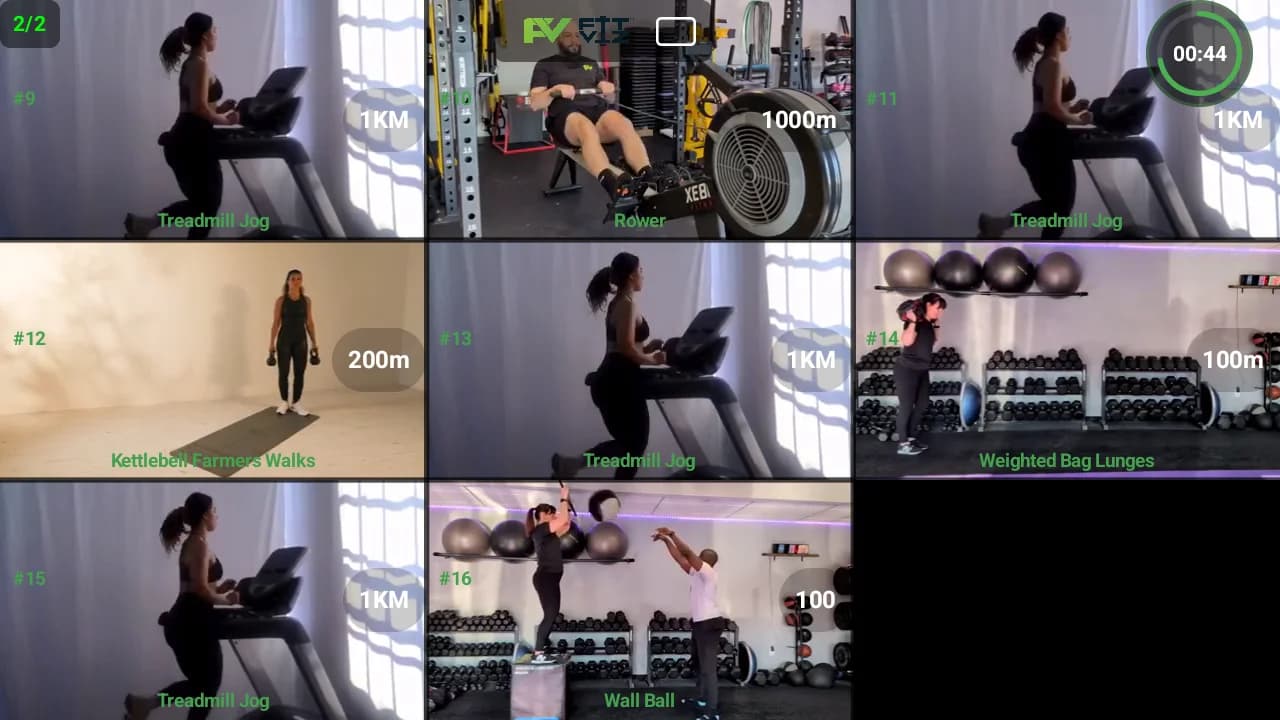
Station flow on the big screen. Gyms running HYROX-style classes use Fit Viz to put all 8 HYROX stations on the wall in race order - current station, work targets, and who's up next - so a class moves through all 8 stations in race order without a coach shouting logistics.
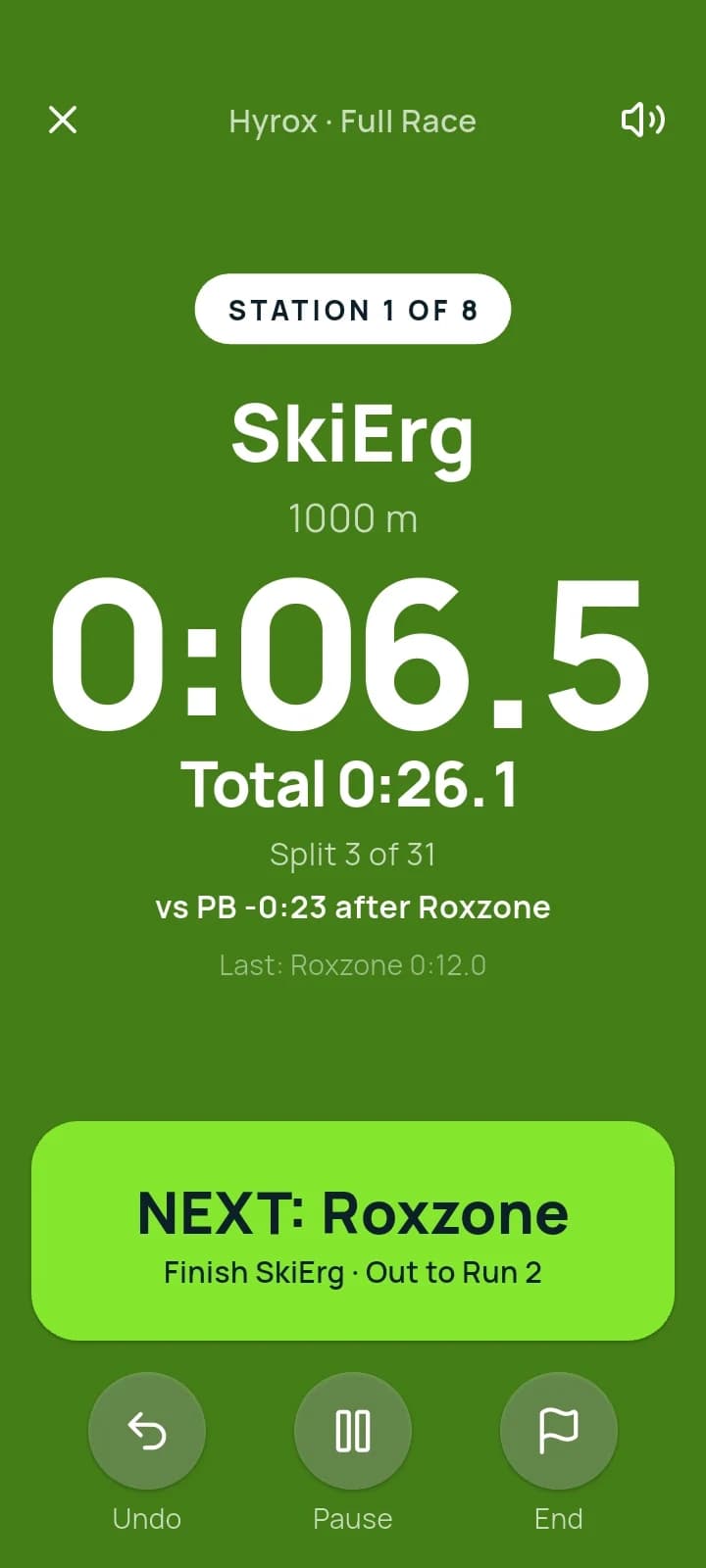
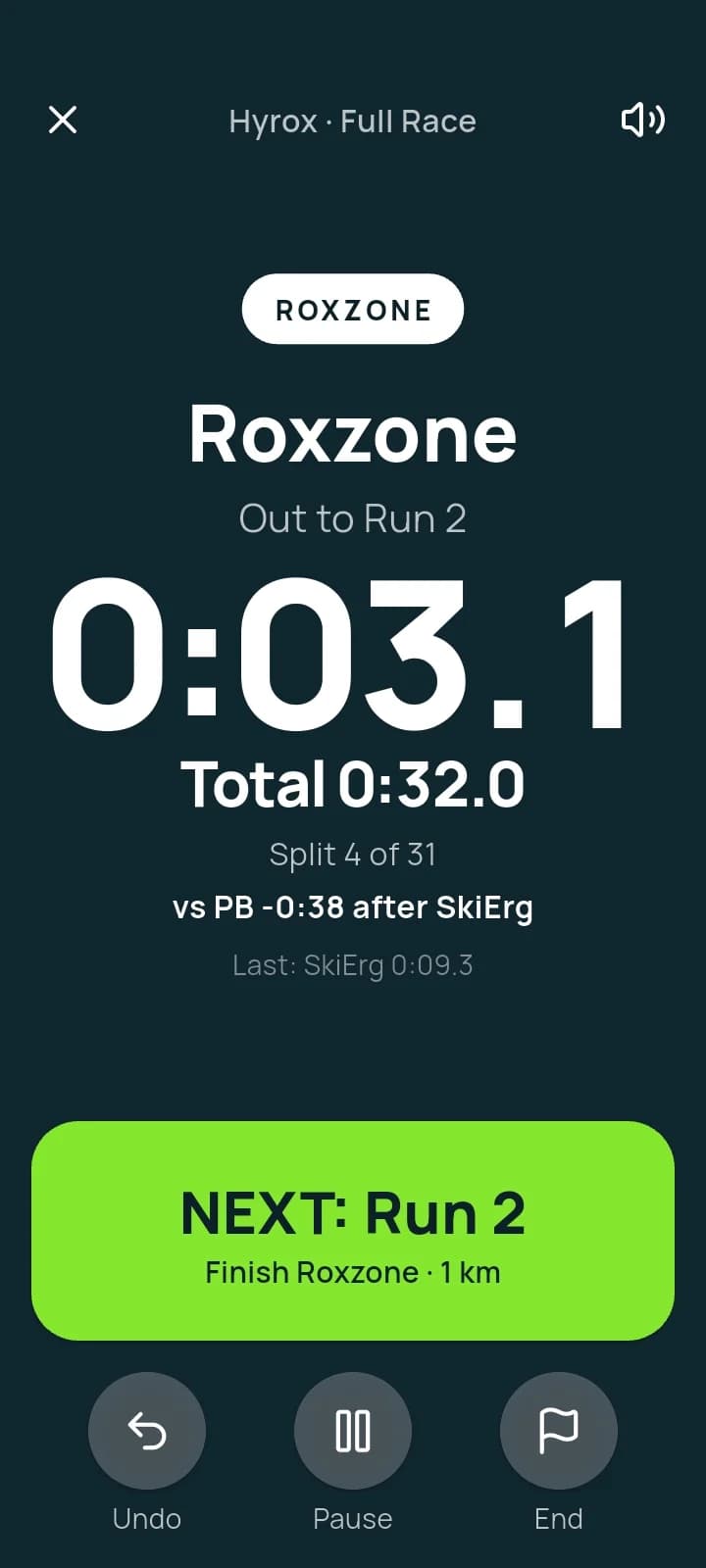
A timer that knows the race. Our free browser HYROX timer runs full and half simulations in official station order with automatic Roxzone capture - and inside the free Fit Viz app, the same engine powers training plans with a built-in station timer that tracks, paces, and records every station, plus an overall HYROX timer for full sims. Your station history builds into pacing insight - and race-day predictions just rolled out.
The plan that uses both. The free 8 & 12-week HYROX training plan schedules station work, compromised-running blocks, and full-order simulations - printable PDF or run-it-in-the-app.
Use our free HYROX timer for pacing during training.
Looking for workouts, not the station list?
This page is the reference for the HYROX stations in order and the race format. If you want actual training sessions - station-focused conditioning pieces, compromised-running workouts, and full simulation days - those live in our HYROX workout examples.
FAQ
What are the 8 stations in HYROX?
In order: SkiErg (1,000 m), Sled Push (50 m), Sled Pull (50 m), Burpee Broad Jumps (80 m), Rowing (1,000 m), Farmers Carry (200 m), Sandbag Lunges (100 m), and Wall Balls (100 reps). Each is preceded by a 1 km run.
What is the order of a HYROX race?
Run 1 km, then complete a station, eight times over: run → SkiErg → run → sled push → run → sled pull → run → burpee broad jumps → run → row → run → farmers carry → run → sandbag lunges → run → wall balls. The order is identical at every event worldwide.
What is the HYROX race format?
8 × 1 km runs alternating with 8 fixed workout stations, indoors, on one continuous clock that includes the Roxzone transitions. Divisions (Open, Pro, Doubles, Relay) change the loads or the work split, never the format.
What is considered the hardest station in HYROX?
Most athletes name the sled push for raw difficulty and wall balls for where races are actually lost - 100 reps on pre-fatigued legs with a no-rep standard. Sandbag lunges are the dark horse: the slowest station, placed immediately before wall balls.
Which HYROX station is the easiest?
Rowing, for most athletes - not because it's light work, but because it's the one station where pacing lets you recover mid-race. Treat it as a controlled reset, not a place to attack.
What is the Roxzone?
The transition area between runs and stations. The clock keeps running there, and it typically decides several minutes of your finish time - our free HYROX timer tracks it automatically so you can train it down.
Do the HYROX stations ever change?
No - the 8 HYROX stations and their order are fixed and identical worldwide; that consistency is what makes global leaderboards possible. What can change between seasons are detail standards in the official rulebooks (equipment specs, judging cues), which is why this guide is re-verified every season.
Part of the:
- HYROX training hub
- Weights by division
- Free 8 & 12-week training plan
- Free HYROX timer
- HYROX workout examples
Independent guide - not affiliated with HYROX GmbH. Standards verified against the official Season 26/27 rulebooks; re-verified each season.