HYROX Workout Examples: 13 Free Sessions, from First Timer to Race Simulation
13 free HYROX workout examples with full prescriptions: beginner sessions, station and grip workouts, doubles partner sessions, half and full race simulations, and no-equipment options - plus how to run them on a timer, in the app, or on your gym's screens.
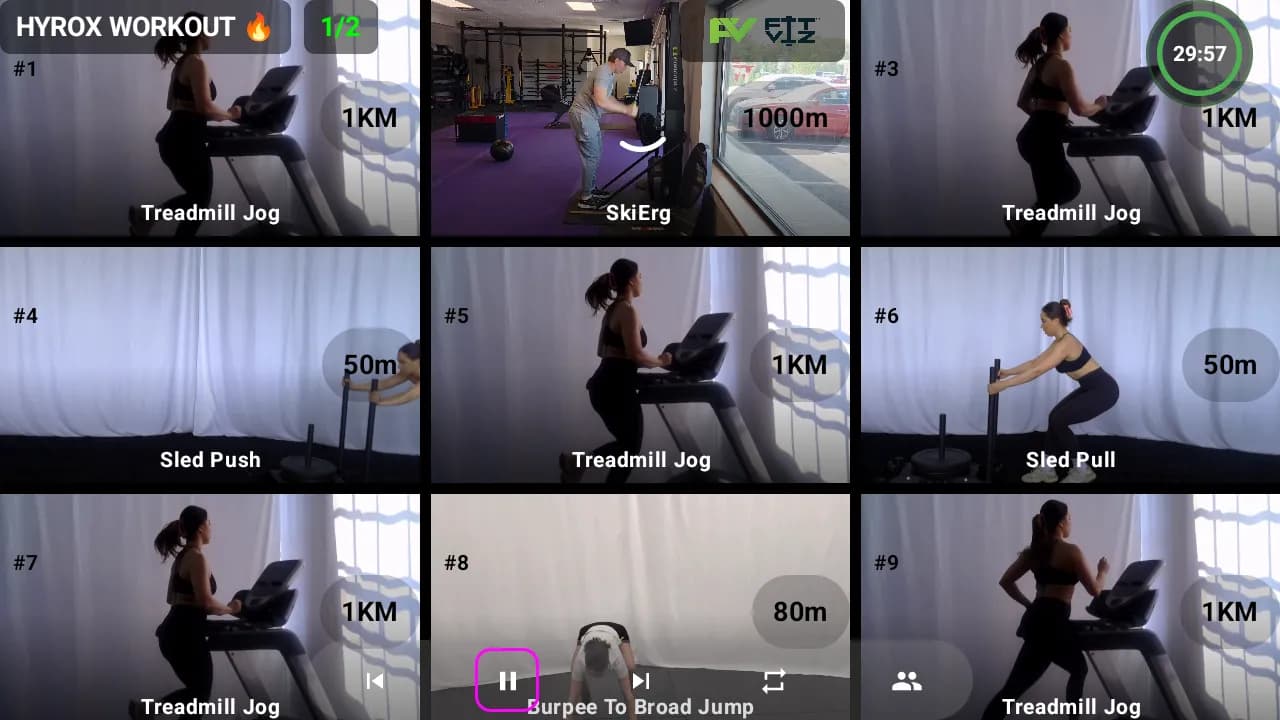
A HYROX workout pairs running with functional stations - ski, sled, jumps, row, carries, lunges, wall balls - so you're always working out on tired legs, the way the race demands. That's the whole trick, and it's why generic circuits don't prepare you for HYROX.
Below are 13 complete HYROX workout examples - real hyrox workouts with full prescriptions, not concepts - that you can run this week: three for beginners, four classic race-prep sessions, two doubles workouts, half and full race simulations, and two no-equipment options for home or hotel. Every session includes a full prescription and a scaling line, and every one of them can run on our free HYROX timer, in the Fit Viz app, or on your gym's screens.
What makes a HYROX workout different
Three qualities separate real HYROX workouts from a hard circuit, they are trained deliberately in the sessions below.
- Compromised running. In the race you never run fresh - every kilometre starts on legs that just pushed a sled or finished lunges. Training this means structuring sessions as run → station → run, not station blocks with rest. It's the single most ignored quality in HYROX training, and the reason first-timers' run splits collapse after station four.
- Transitions. The clock never stops between runs and stations, and untrained athletes leak minutes in the Roxzone. The sessions below treat the changeover as part of the work: move immediately, breathe while you walk, equipment ready. (Our free HYROX timer captures transition time automatically, so you can watch that leak shrink.)
- Race doses. The third ingredient is volume honesty. A HYROX workout earns its name when the doses relate to the race: wall balls in the tens (you'll do 100 on the day), carries by the hundred metres, runs by the kilometre. Cute 30-second station blasts build sweat, not finish times - every session below is scaled from the race backwards, which is also why the loads always reference race weight rather than a number that ignores your division.
One more scope note: this page gives you sessions.
- For what each movement must look like to a judge, see: The HYROX exercises standards guide;
- For the race sequence itself, the stations guide;
- For every division's loads, the weights table.
Which HYROX workout should you start with?
Match the session to the question you're trying to answer.
- Never done this before? Start with workouts 1–3 in order.
- Eight weeks from a race and wondering where your time will leak? The Grip Stacker (4) and the Sled Sandwich (5) will tell you.
- Racing doubles? Sessions 8–9 are your weekly ritual.
- Want an honest verdict on your goal time? The Half Sim (10), then the full simulation (11) three weeks later.
- Traveling? 12–13 pack flat.
However you enter, the best HYROX workout is the one that attacks the quality you'd currently lose the most minutes to - pick uncomfortably, not conveniently.
Beginner HYROX workouts
Start here if you've never trained the race pattern. These beginner HYROX workouts keep loads at 50–75% of race weight and volumes at half race dose - the priority is pattern over pace. Run them once each across your first two weeks, repeat the cycle with slightly heavier loads in weeks three and four, and you'll arrive at the classic workouts below already understanding the one thing that matters: what your legs feel like when the run starts after the work. That feeling is HYROX; everything else is detail.
1. The First Brick (30–35 min · any gym)
4 rounds: 400 m run → 10 wall balls (light, full depth, real target) → 400 m run → 20 m walking lunges (bodyweight) → rest 90 sec. Purpose: Your first taste of compromised running - and of full-depth wall balls to a real target, the standard most first-timers meet too late. Scale: Drop to 3 rounds; walk the second 400 m if form breaks.
2. Machine Meets Legs (35 min · erg access)
3 rounds: 500 m SkiErg or row (conversational pace) → 500 m run → 15 air squats + 10 burpees → rest 2 min. Purpose: Learn to run off a pulling machine - the race does it to you twice, and the first 200 m after an erg teaches you more about HYROX pacing than any article. Scale: 350 m erg intervals; step-down burpees.
3. The Beginner Sampler (40 min · functional area)
2 rounds: 500 m run → 25 m sled push (light) → 500 m run → 25 m sled pull (light) → 500 m run → 40 m farmers carry (moderate) → 500 m run → 25 wall balls. Purpose: Half-dose tour of the race's grip-and-legs stack, in race order, so the sequence stops being theory. Treat it as a diagnostic: whichever station slowed your next run the most is your first training priority. Scale: Substitute a heavy plate push on carpet if there's no sled - full options in the exercises guide.
Classic HYROX workouts for race prep
The intermediate core - four example workouts at full race doses, each emphasizing one quality the race will test. Rotate through all four across a training week or two rather than repeating a favourite: the race has no favourite stations, and balanced HYROX workouts now prevent a twelve-minute wall-ball hole later. Each session lists its purpose so you always know what you're buying with the fatigue.
4. The Grip Stacker (45 min)
4 rounds: 800 m run → 25 m sled pull → 100 m farmers carry at race weight → 30 sec dead hang → rest 90 sec. Purpose: the race punishes grip twice - sled pull, then farmers carry - and this session rehearses surviving both in one fatigued state. The dead hang at the end is the honesty test. Scale: reduce carry distance before reducing weight.
5. The Sled Sandwich (40 min)
5 rounds: 400 m run → 50 m sled push at race weight → 400 m run → rest 2 min. Purpose: The hardest brick in HYROX, isolated. Run the 400s at goal race pace - the point is holding pace after the sled. Scale: 25 m pushes, 3 rounds.
6. The Wall Ball Closer (45 min)
3 rounds: 1 km run → 20 m sandbag lunges → 30 wall balls unbroken-as-possible → rest 2 min. Finish: 40 extra wall balls in planned sets of 10. Purpose: The race's final ten minutes, rehearsed tired - lunges into wall balls is where finish times are decided, and planned break points beat heroic failure every time. Scale: Lighter ball - never a lower target; standards practised sloppy stay sloppy.
7. The Engine EMOM (32 min)
EMOM 32 (8 blocks of 4 min): min 1 - 200 m run · min 2 - 12 cal SkiErg or row · min 3 - 10 burpee broad jumps · min 4 - rest. (Adjust EMOM timer to 32 Minutes) Purpose: Repeatable pacing under a clock; a hyrox style workout that fits any commercial gym floor with no sled required. If minute three's jumps get slower every block, your engine - not your legs - is the project. Scale: 10 cal and 8 jumps.
HYROX doubles workouts
In doubles you run every kilometre together and split the station work - so these hyrox partner workout sessions rehearse the split decision, not just share the load. The strongest doubles teams aren't two strong athletes; they're two athletes who decided in training who takes the first half of the wall balls, how the sled gets split, and what the handover looks like when one partner is redlining. (Division rules and doubles loads are in the weights table.) Run one of these two HYROX workouts together every week in your last two months before racing.
8. You-Go-I-Go (40 min · pairs)
5 rounds: 400 m run together → station block split 50/50, switching every 20 sec of work: 40 wall balls · 40 m sled push · 40 cal row (rotate the station each round) → rest 90 sec. Purpose: practise fast handovers - the transitions between partners decide doubles races, and 20-second switches force more of them per round than the race ever will. Scale: 30 sec work switches for newer pairs.
9. The Split Sim (50 min · pairs)
4 stations at race dose, split by strategy, 800 m run together between each: SkiErg 1,000 m → sled push 50 m → farmers carry 200 m → wall balls 75. Purpose: A doubles partner workout that forces the "who leads what" conversation before race day - including the one nobody wants: what's the signal when a partner needs to hand over early? Decide splits in advance; review after, honestly.
HYROX simulation workouts
Simulation is where training becomes racing: the full sequence, the real transitions, the honest answer about your pacing. A hyrox simulation workout is also the single best predictor of your finish time - which is why both sessions below belong on a clock.
10. The Half Sim (45–60 min)
In order, at race doses where equipment allows: 1 km run → SkiErg 500 m → 1 km run → sled push 25 m → 1 km run → farmers carry 100 m → 1 km run → wall balls 50. Purpose: the classic session-sized rehearsal - week 9 of our free 12-week program uses exactly this shape. Tap every transition on the free HYROX timer and read your Roxzone total at the end.
11. The Full HYROX Workout (race simulation) (70–100 min · treat it like race day)
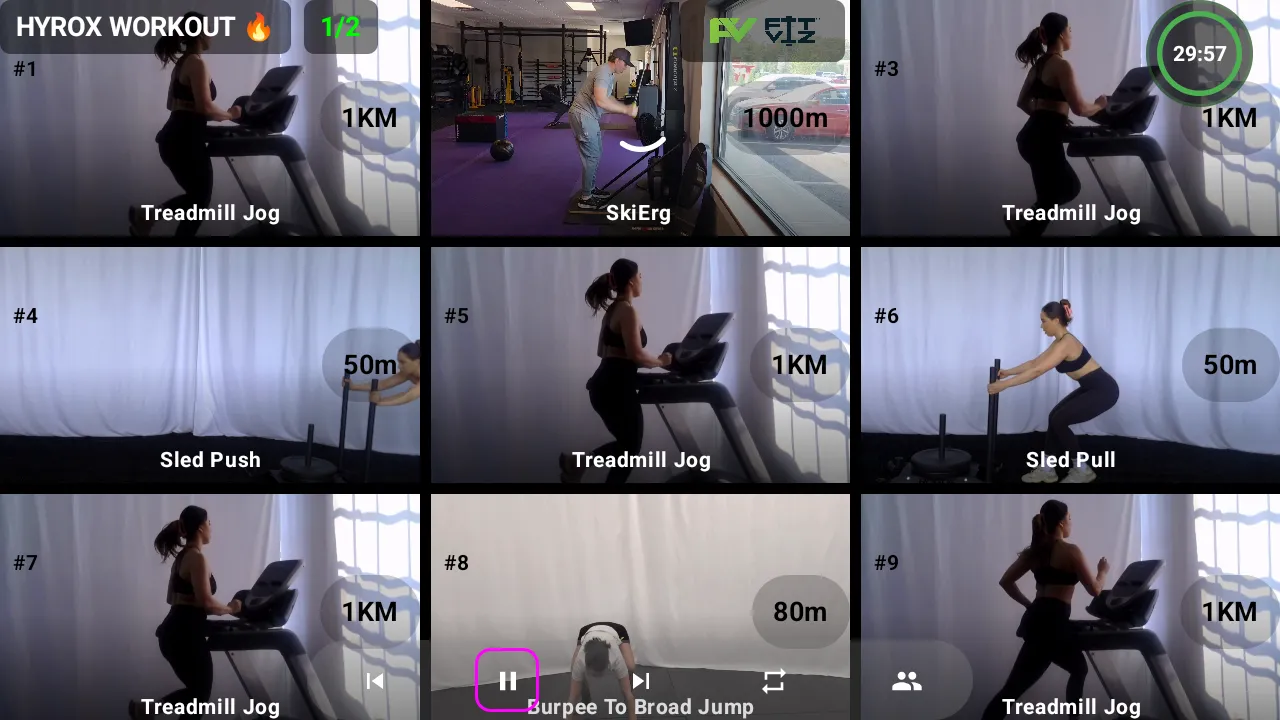
The complete sequence at race dose: 8 × 1 km runs alternating with SkiErg 1,000 m · sled push 50 m · sled pull 50 m · burpee broad jumps 80 m · row 1,000 m · farmers carry 200 m · sandbag lunges 100 m · wall balls 100. Purpose: the full hyrox simulation workout - the dress rehearsal. Run it no more than once every 3–4 weeks and never in race week; treat it with race-day seriousness: fuel, pacing targets, full standards. Pace it 15–20 sec/km slower than goal on the first three runs.
Full sequence details live in the stations guide.
Log both simulations and the comparison writes your race plan for you: where the Roxzone leaked, which station broke pace, what the second half cost. (In the Fit Viz app the station timer records these splits automatically, and race-day predictions have just rolled out.)
HYROX workouts at home (no equipment)
No sled, no ergs, no problem - half the race is running and bodyweight anyway, and a hyrox workout at home keeps the pattern alive between gym sessions. (Every substitute for the equipment stations is catalogued in the exercises guide, so a hotel week never has to be a lost week.)
12. The Runner's HYROX (35 min · anywhere outdoors)
5 rounds: 800 m run → 15 burpee broad jumps → 20 walking lunges → 15 air-squat jumps → no rest, straight back to the run. Purpose: compromised running with zero equipment - the burpee broad jumps and lunges are literal race movements, so this doubles as standards practice. Scale: 600 m runs, standard burpees.
13. The Hotel Room Special (25 min)
AMRAP 25: 40 mountain climbers → 20 alternating lunges → 15 burpees → 10 jump squats → 60 sec stair run or high knees. Purpose: travel-week maintenance that keeps the legs-then-lungs pattern alive. Scale: fixed 5 rounds instead of AMRAP.
Putting the sessions into a week
Two or three of these HYROX workouts a week - one beginner/classic, one station or grip emphasis, one longer run or simulation - covers most athletes' needs alongside easy running.
The full 12-week progression with deloads, benchmark tests, and a printable PDF is the job of our free HYROX training plan; this page is the session library it draws from.
Pacing by heart-rate zone makes every session above measurable - run the intervals in Zone 3–4 and let recovery minutes drop you back to Zone 2. HR tracking in Fit Viz turns that from theory into a number on the screen.
For the complete week-by-week structure with deloads and benchmarks, follow our free 12-week program.
Pacing: heart-rate zones make every session measurable
The difference between a productive HYROX workout and an expensive one is usually pace, not effort. Three zone rules cover the sessions above. Run intervals in Zone 3–4 - hard but repeatable; if round two's 400 m is ten seconds slower than round one's, you bought fatigue, not fitness. Let rest minutes do their job: walk, breathe, and watch your heart rate drop toward Zone 2 before the next round - if it won't drop, the session is telling you to scale. And in simulations, cap the first three runs at 15–20 seconds per km slower than goal pace; every simulation that starts "banking time" ends with a wall-ball meltdown. Zones turn all of this from feel into numbers - HR tracking in Fit Viz puts live zone colour on the screen while you work, which is how coaches keep a whole class honest at once.
Station efficiency: the free speed in every session
The live clock between stations is where untrained athletes give away 8–12 minutes on race day, so treat every workout above as transition practice too. Three drills cost nothing: rack-to-run - the moment work ends, move; no standing over the sled admiring it. The breathe-walk rule - transitions are for lowering your heart rate on the move, not at a standstill. Equipment staged before you start - wall ball at the target, kettlebells at the line, so the workout never pauses to set up. Athletes who rehearse transitions in training routinely take four to six minutes off a first race without getting any fitter. It is the cheapest speed in the sport.
Run these on a screen, a timer, or in your pocket
Reading a workout is one thing; running it well is another. Every session on this page exists in the Fit Viz session library as a structured workout - rounds, work, transitions - which means three things:
-
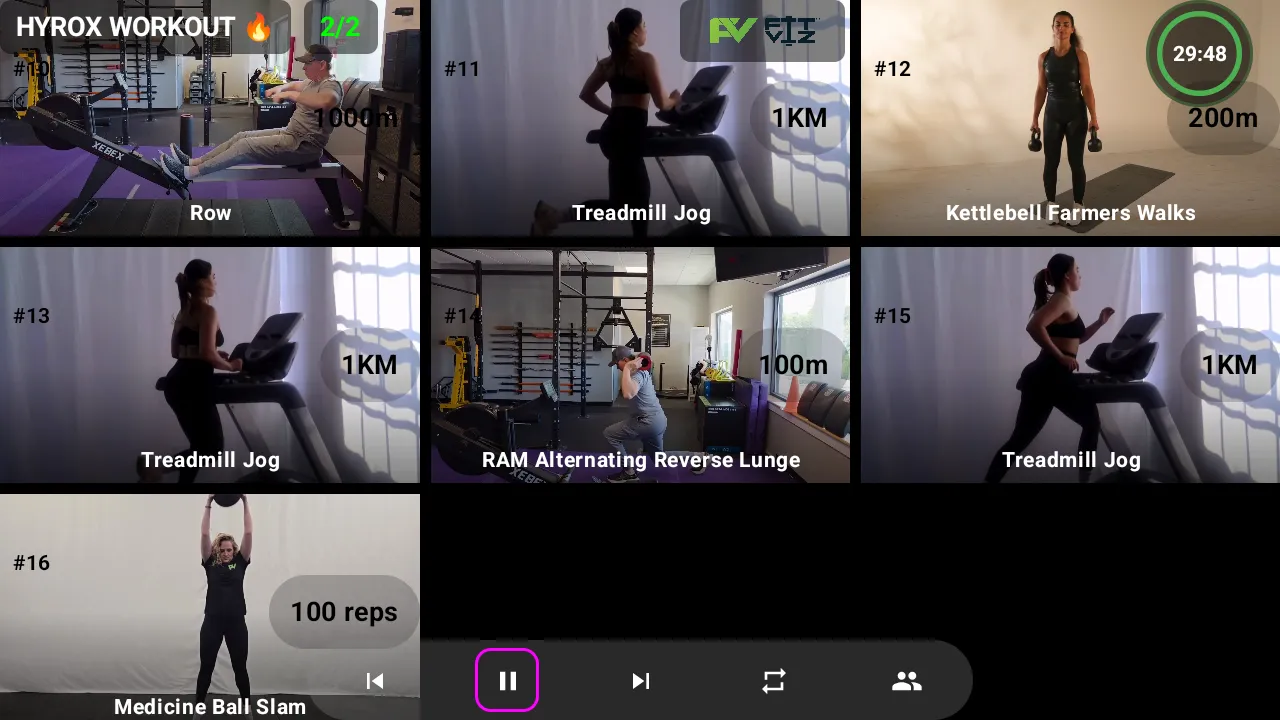
On your gym's screens: coaches load the session and the whole floor sees the flow - work, transitions, who's up - without a whiteboard huddle. It's how gyms run HYROX-style classes at scale, and the same library powers our display features.
-
In your browser: the free HYROX timer runs the sims with automatic transition capture - no signup.
-
In the app: the free Fit Viz app tracks your station splits and history; if you're comparing options, our training app guide reviews every app in the category honestly.
Make these workouts yours
Thirteen sessions is a library, not a prescription. The athletes who improve fastest run the same HYROX workouts on a cycle and race their own logbook: same session, three weeks later, two fewer breaks on the wall balls, eight seconds faster on the post-sled run. Progress in this sport is boringly measurable - which is exactly why it responds so well to structured repetition. Pick four sessions, repeat them for a month, and let the numbers argue.
Searching for "high rocks workout" or "hi rox"?
Same race - it's spelled HYROX (one word, all caps), though search data says thousands of athletes type "high rocks workout," "high rox," or "hi rox workout" every month. If that's how you landed here, you're in the right place: the 13 HYROX workout examples above are exactly what that search was looking for, and the beginner's overview explains the race itself in five minutes.
Related:
- HYROX training hub
- Free 8 & 12-week HYROX training plan
- Stations & race sequence
- Exercise standards & substitutes
- Weights by division
- Free HYROX timer
- Best HYROX training apps
- HYROX vs CrossFit
Independent guide - not affiliated with HYROX GmbH. Race doses verified against the official Season 26/27 rulebooks; re-verified each season.