Digital Fitness Platforms: What They Are, the Six Types, and How to Choose in 2026
A digital fitness platform is an app or connected service that delivers training digitally - workout programs, live or on-demand classes, performance tracking, and increasingly AI coaching that adapts to your body - on your phone, watch, and TV.
The category now spans everything from class libraries to AI coaches to the app your gym runs on, and picking wrong costs months.
This guide maps the six types of digital fitness platforms, what each really costs, and the five tests that pick the right one.
The six types of digital fitness platforms
- 1.Class and content libraries. Thousands of on-demand classes - Peloton App, Les Mills+, FitOn, Apple Fitness+ - the biggest online fitness platforms. Great production; the program doesn't know you. Best for variety-driven exercisers.
- 2.AI-adaptive coaching platforms. The program changes daily based on your readiness, recovery, and logged performance - FitViz, Fitbod, Juggernaut AI. The FitViz app reads HRV and sleep into a morning readiness score, then builds that day's session to match, with voice guidance while you train. This is the type growing fastest, because an AI fitness app closes the loop content libraries leave open: it knows what you did and what you can do today.
- 3.Logging and tracking platforms. You bring the program; they keep the record - Hevy, Strong, Strava. Essential, and increasingly a feature inside type 2 rather than a separate app.
- 4.Coach-delivery platforms. A human coach program; the platform delivers - the online coaching stack. (Coaches: that's our personal trainer software territory - no per-client fees.)
- 5.Community and challenge platforms. Leaderboards, clubs, segments - Strava again, plus race-specific ecosystems. (Training for HYROX? The HYROX training app field is its own comparison.)
- 6.Hybrid gym member platforms. The digital fitness platform your gym runs - booking, the class on the gym's screens, your heart rate in the room, your log in your pocket. One membership, both worlds. This is where FitViz is unusual: the same platform serves the gym's whole stack and the athlete's own training, so your data doesn't split when you train in both places.
What digital fitness platforms cost
Free tiers (FitOn, Boostcamp, Nike Training Club, FitViz's free plan) · content subscriptions - $10-$45/month (Peloton, Les Mills+), AI Coaching $10-$35/month (Fitbod, Juggernaut AI; FitViz Pro runs a 14-day free trial) · human coaching $100-$400+/mo. The honest rule: pay for adaptation or pay for accountability - paying twice for content you can get free is the category's biggest waste. And read renewal prices: an online fitness platform's intro month is rarely its real price.
The five tests for choosing a digital fitness platform
Does it adapt? If you miss a week or sleep badly, does tomorrow's workout change? A readiness-aware platform adjusts; a library just plays the next video.
Does it fit your devices? Your watch is your heart-rate sensor - check Android, Apple Watch, and Garmin support before anything else. (FitViz pairs all three; here's how.)
Does it coach while you train? Zones on screen, voice cues mid-set, rest timed for you - or are you reading a PDF between sets? Our heart rate zones guide explains what live intensity coaching should look like.
Does it keep your whole picture? Workouts, meals, recovery in one record beats three apps that don't talk. (Logging meals in FitViz.)
Can you leave? Your training history is yours - check export before you build years of data somewhere.
Free Platform Chooser Checklist
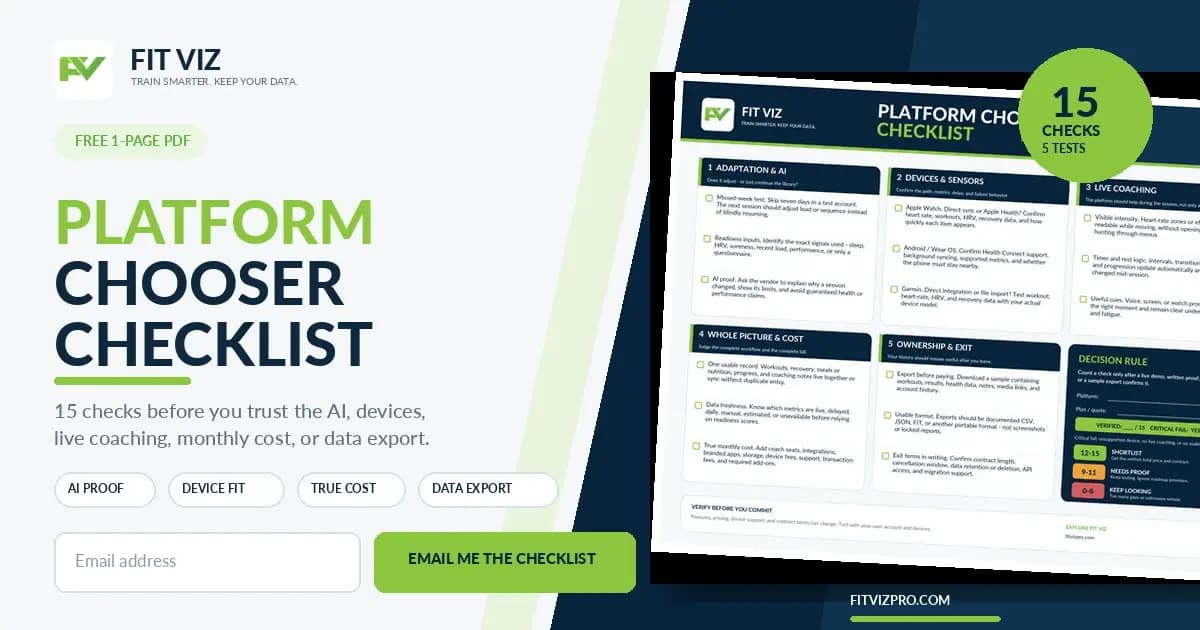
Choose a Fitness Platform With Evidence—not Marketing Claims
Before you trust an app with your workouts, recovery data, connected devices, and training history, run it through 15 practical checks.
The free Fit Viz Platform Chooser Checklist expands the five essential buying tests into a printable, one-page decision tool.
Inside the checklist:
- 1.Adaptive programming and AI claims worth trusting
- 2.Apple Watch, Android, Wear OS, and Garmin compatibility checks
- 3.Live heart-rate, timer, rest, and coaching requirements
- 4.Whole-picture workout and recovery data
- 5.Real monthly cost after add-ons and required integrations
- 6.Export quality, contract terms, and your right to leave
- 7.A simple proof-based scoring system
We’ll send the one-page PDF directly to your inbox. You may also receive occasional training, recovery, and fitness-platform resources from Fit Viz. Unsubscribe anytime.
Where FitViz sits, honestly
FitViz is a type 2 AI-adaptive platform with type 3 logging and type 6 gym integration built in: readiness-scored mornings, adaptive daily programming, live heart-rate zones with voice guidance, workout and meal logging, and five program lines from strength to endurance. What it isn't: a 3,000-class video library - if cinematic classes are the goal, Peloton and Les Mills+ earn their fee. For the full app field, see our best fitness apps and best workout apps guides.
Coach or trainer? The same ecosystem runs your client side - start free as a coach, or see the personal trainer software page.
Frequently asked questions
An app or connected service that delivers training digitally - programs, classes, tracking, and increasingly AI coaching - across phone, watch, and TV. The six types range from class libraries (Peloton) to AI-adaptive coaches (FitViz, Fitbod) to the hybrid platform your gym runs.
Every platform ships as an app, but a platform implies the connected system around it - wearable data in, adaptive programming out, history that compounds. A standalone timer is an app; an AI coach reading your HRV is a platform.
Across digital fitness platforms it depends on type: FitViz for AI-adaptive coaching with readiness and heart-rate depth; Peloton or Les Mills+ for class libraries; Hevy or Strong for pure logging; Strava for community. The five tests above decide faster than any ranking.
The test is concrete: log a terrible night's sleep or skip a week, and see if tomorrow's session changes. Genuine adaptive platforms (FitViz, Fitbod, Juggernaut AI) visibly adjust load, volume, or exercise selection; libraries with an "AI" label play the next video regardless.
The good ones pair with Android, Apple Watch, and Garmin for live heart rate - FitViz supports all three. Always check your specific device before subscribing anywhere.
For programming and progression, increasingly yes; for accountability, form correction, and the person who notices you - not yet. The hybrid answer is common: an AI platform daily, a coach for check-ins. (Coaches deliver that through FitViz for trainers.)