Back to Blog
Technology

15 EMOM workouts by skill level

15 EMOM workouts split across beginner, intermediate, and advanced, with exact per-minute prescriptions, durations, and scaling notes for rowing, kettlebells, wall balls, and barbell work.

G
Geoffrey
Technology & Operations
Sep 2, 2026
11 min read
EMOMEMOM WorkoutsWorkout TimerCrossFitInterval Training
15 EMOM workouts by skill level - Featured image

An EMOM (every minute on the minute) starts a fresh interval every 60 seconds. You do the prescribed work, then rest whatever is left of the minute, then a new minute starts whether you are ready or not. That structure is the entire appeal: the clock enforces pace, and the rest is built in rather than negotiated.

Here is the mistake almost every beginner makes: they pick a rep count that takes 55 seconds to complete. That is not an EMOM, it is a grind with a 5-second breather stapled on. The rest is not a bonus, it is the point. A well-built EMOM leaves you 15 to 30 seconds of dead time in most rounds, and it is that dead time that lets you hold the same output in round 12 that you hit in round 2. If you are gasping through the last rep as the next minute starts, the workout is not testing your fitness, it is testing whether you can do math under duress. Fix the rep count, not your effort.

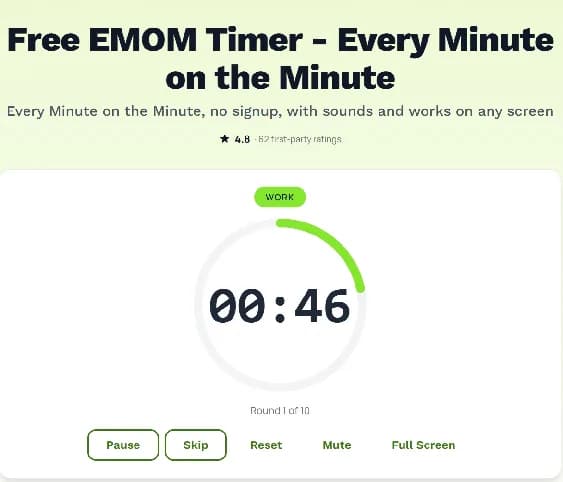
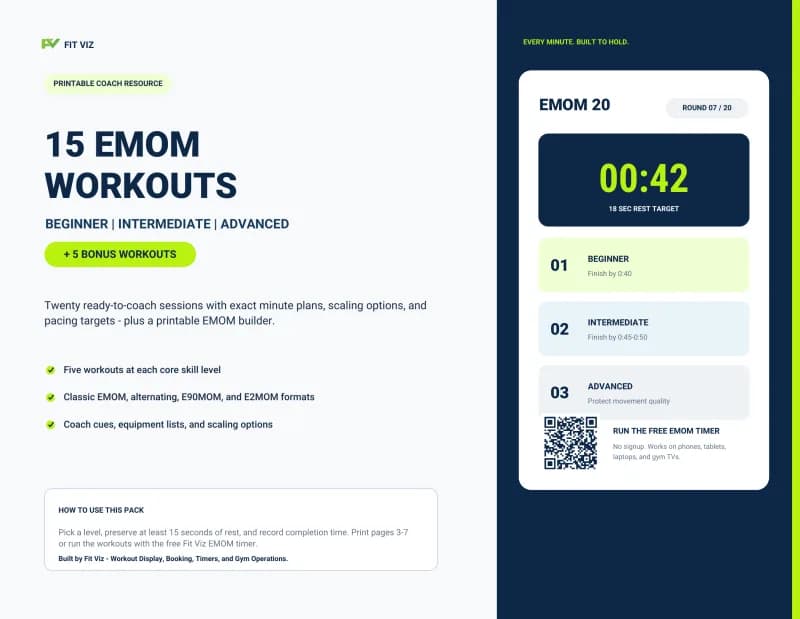
This guide has 15 EMOM workouts, five per skill level: beginner, intermediate, and advanced. Every one has an exact per-minute prescription, a total duration, and a note on what it trains or how to scale it. Run any of them on the EMOM timer, which opens each round with a bell and carries you into the switch with countdown beeps. For the full library of interval formats, see the workout timer hub.

How to read these

Each workout lists the total duration, what happens every minute, and which minutes (if any) alternate between two movements. "Rounds" means total minutes, not total sets of paired movements, unless stated. Scale any of these down by cutting reps until you get real rest back, not by cutting the clock short.

Loads are given as men's/women's in pounds (lb) unless a single number is listed, and box heights are in inches (in). Where a percentage of 1RM is prescribed, use your most recent tested or reasonably estimated max for that specific lift, not a number from a different movement. A squat clean percentage should come from a squat clean max, not a back squat max.

Which level should you start at

Skill level here is about movement proficiency under a clock, not general fitness. Ask three questions before picking a workout.

Can you do the prescribed reps unbroken, without breaking form to chase the clock? If a movement in the workout requires you to stop and reset mid-set, drop down a level or scale that movement individually rather than the whole session.

Have you run an EMOM before and stayed oriented on which round you are on without checking a whiteboard every 20 seconds? Round-tracking is its own skill. The EMOM timer shows the current round and time remaining on screen, which removes that problem, but the beginner workouts below are still built assuming you are new to the format itself.

Do you know your rough working loads for kettlebell swings, wall balls, thrusters, and cleans? The intermediate and advanced workouts prescribe percentages and specific loads. If you do not know your numbers, run a beginner or intermediate workout first and note what felt sustainable, then use that to pick weights for the next tier.

If in doubt, run one level down from where your ego says you belong. An EMOM that is slightly too easy still builds pacing discipline. An EMOM that is too hard just turns into a series of missed minutes, which teaches you nothing except that you picked wrong.

Beginner EMOM workouts

Beginner here means new to structured interval training, not new to exercise. The rep counts below should leave 20+ seconds of rest in most rounds if you are working at a controlled pace.

1. First minute (10 minutes)

Every minute: 8 kettlebell swings, 6 air squats.

A flat introduction to the format with two movements almost anyone can do unbroken. The goal on this one is not intensity, it is learning to reset on the minute instead of resting on your own clock. Scale by dropping to 6 swings and 4 squats if round 8 still feels rushed.

2. Row and hold (12 minutes)

Every minute: 12/9 calorie row, then rest.

A single-movement EMOM that teaches pacing on the rower specifically. Pull at roughly 70% effort so the calorie count comes in around 30-35 seconds, leaving the back half of the minute for recovery. If you are still pulling past 45 seconds, drop to 10/7 calories.

3. Push-pull basics (14 minutes)

Alternating minutes: odd minutes 8 push-ups, even minutes 8 ring rows (or 8 assisted pull-ups).

Introduces alternating EMOMs, where the movement changes every other minute instead of every minute. This keeps opposing muscle groups working while the other recovers. Scale push-ups to an elevated surface if 8 unbroken is not there yet.

4. Wall ball intro (10 minutes)

Every minute: 8 wall balls, 30 seconds easy step-ups.

The wall ball rep count is intentionally light. The 30-second step-up block is not "extra work," it is active rest that keeps the heart rate elevated without adding load. This is a good first exposure to combining a loaded movement with low-load filler.

5. Bike and breathe (15 minutes)

Every minute: 15 seconds hard on an assault bike (or 10 calories on any bike), rest the remainder.

Short, sharp effort followed by a long rest window, closer to interval conditioning than strength-endurance. This is the easiest workout on the beginner list to actually finish at full effort every round, which makes it a good benchmark for tracking pace improvement over weeks.

Intermediate EMOM workouts

Intermediate assumes you can do the core movements unbroken at moderate reps and have run a handful of EMOMs already. Expect 10-20 seconds of rest most rounds, tighter in the back half.

6. The classic 15 (15 minutes)

Every minute: 10 burpees.

One movement, no variation, no hiding. Burpees at 10 reps a minute is a standard benchmark precisely because it is simple to prescribe and brutal to sustain. Track your average rep-completion time across the 15 rounds; if it climbs past 40 seconds by round 10, that is your pacing ceiling for next time.

7. Double trouble (16 minutes)

Alternating minutes: odd minutes 30 double unders, even minutes 10 kettlebell swings (53/35 lb).

Pairs a skill-dependent movement (double unders) with a strength-endurance movement (swings) so a bad rope day does not sink the whole workout. If double unders break down, sub 45 seconds of single unders for the odd minutes.

8. Squat clean ladder (12 minutes)

Every minute: 5 squat cleans at a moderate load (roughly 60% of 1RM).

A barbell-technique EMOM at moderate load and higher volume than a strength piece, designed to groove the squat clean under mild fatigue rather than test a max. If the bar speed drops noticeably by minute 8, drop to 3 reps for the remaining rounds rather than missing lifts.

9. Row-bike-row (18 minutes)

Every minute: minutes 1-6 row 12/9 calories, minutes 7-12 bike 12/10 calories, minutes 13-18 row 12/9 calories.

Three six-minute blocks on two machines. The middle block on the bike forces a different muscle recruitment pattern right when the legs are starting to feel the row, and the final row block tests whether that switch actually gave you anything back.

10. Thruster and climb (20 minutes)

Alternating minutes: odd minutes 8 thrusters (75/55 lb), even minutes 3 strict pull-ups.

Full-body loaded movement paired with a strict pulling movement, 10 rounds each. Strict pull-ups (not kipping) are deliberate here, they cap the pace and make the workout about quality reps rather than a race. Sub ring rows if 3 strict pull-ups per round is not sustainable past round 6.

Advanced EMOM workouts

Advanced assumes solid technical proficiency under fatigue and comfort loading barbell movements at moderate-to-heavy weight inside a tight time window.

11. The grinder (20 minutes)

Every minute: 12 wall balls (20/14 lb), 5 burpees.

Two movements every single minute for 20 rounds, with a combined rep count that leaves very little margin. This is a pacing test above all else: go out too hot and you will be over 55 seconds by round 10. The intent is to hold the same round time from minute 1 to minute 20, not to blow up early and survive.

12. Heavy clean E2MOM (12 rounds, every 2 minutes, 24 minutes total)

Every 2 minutes: 2 power cleans at 80-85% of 1RM.

This is where the E2MOM variant matters: 2 heavy cleans do not belong in a 60-second window with a real warm-up-to-weight jump between rounds. The 2-minute window gives you time to reset your setup and hit each pair with full intent instead of rushing the second rep to beat the clock.

13. Box jump and swing ladder (18 minutes)

Alternating minutes: odd minutes 10 box jumps (24/20 in), even minutes 15 kettlebell swings (70/53 lb) at heavy load.

High-impact box jumps paired with heavy swings, 9 rounds each. Step down off the box every rep rather than jumping down, this workout accumulates enough total jump volume that rebounding off the box is where ankles and knees get hurt.

14. Push press E90MOM (10 rounds, every 90 seconds, 15 minutes total)

Every 90 seconds: 5 push presses at 70% of 1RM, plus max cardio (row or bike) for the remainder of the interval.

The E90MOM variant here does double duty: 90 seconds is enough room for 5 quality push press reps at real load, and the leftover time (usually 45-60 seconds) becomes a max-effort cardio push rather than passive rest. Track calories on the cardio piece across rounds, that number tells you how much the barbell work is costing you.

15. The long haul (30 minutes)

Alternating minutes across 3 movements on a 3-minute cycle, repeated 10 times: minute 1 of each cycle, 15/12 calorie row; minute 2, 8 thrusters (95/65 lb); minute 3, 12 toes-to-bar.

Ten full cycles of three different movements is 30 minutes of sustained decision-making under fatigue: row, barbell, gymnastics, repeat. Nothing here is prescribed at a shocking rep count, the difficulty is entirely in holding the same quality on cycle 10 that you had on cycle 1. This is a repeatability test, not a max-effort test, and it belongs at the end of a training block, not the start.

Variants worth knowing

Three adjustments cover most of what does not fit a plain 60-second EMOM.

E90MOM. Every 90 seconds instead of every minute. Use it when the prescribed work genuinely needs more than a minute to complete with good form, like workout 14 above. It is not a way to make an EMOM easier, it is a way to fit heavier or longer work into the same rest-enforced structure.

E2MOM. Every 2 minutes. Reserve this for near-maximal strength work, like workout 12, where the point is spacing a small number of high-quality attempts far enough apart that each one is fresh.

Alternating EMOMs. Instead of the same movement every minute, two movements swap on odd and even minutes (workouts 3, 8, and 13 use this). This keeps a workout from becoming monotonous, lets you pair a skill movement with a strength movement, and gives fatiguing muscle groups a full minute to partially recover before their next turn.

None of these change the core rule. Whatever the interval length, the rep count has to leave real rest inside it. An E2MOM with work that takes 115 seconds is exactly the same design failure as a 60-second EMOM that takes 58.

Progressing between levels

Do not jump from beginner straight to advanced because the beginner workouts felt easy in week one. The gap that matters is not total volume, it is load and movement complexity under a shrinking rest window.

A reasonable path: spend two to three weeks on the beginner five, tracking whether your rest window stays above 20 seconds through the last round of each. Move to intermediate once that holds true for at least three of the five beginner workouts in the same session week. From intermediate to advanced, the gate is technical, not just conditioning: can you hit the barbell positions in workout 8 (squat clean ladder) with the bar moving at the same speed in round 10 as round 2? If the bar slows down and your form drifts, that is a strength and technique gap, not a conditioning one, and no amount of EMOM volume fixes it. Put time into the lift outside the EMOM format before you push the advanced workouts.

Building a week from these 15

You do not need to run a new EMOM every session. Repeating a workout every 3-4 weeks and comparing your rest window round-over-round is more useful for tracking progress than constant novelty.

A sample intermediate week might look like this:

  • Monday: workout 6 (The classic 15) for a straightforward conditioning benchmark.
  • Wednesday: workout 8 (Squat clean ladder) for barbell technique under mild fatigue.
  • Friday: workout 9 (Row-bike-row) for a longer aerobic session with a machine switch.

Leave at least one full rest or easy day between EMOM sessions that share a movement pattern, particularly anything loading the shoulders (thrusters, push presses, wall balls) or the posterior chain (cleans, swings, box jumps). Two heavy lower-body EMOMs back to back is how the fifth rep of workout 12 turns into a form breakdown rather than a clean pull.

Running these on a screen

The EMOM timer handles the interval math for any of the 15 workouts above, including E90MOM and E2MOM rounds and alternating-minute setups. It opens each round with a bell and uses countdown beeps to carry you into the next switch. It does not have voice cues, sound packs, or an app to install, that is a deliberately lean web tool. Voice-guided cues and pick-your-pack sounds live in the FitVizPro app on iOS and FitViz on Android.

For a gym running one of these workouts in front of a class, a saved preset can be opened in a TV's browser and run full-screen so the whole room sees the same clock. If your studio is set up with a dedicated display system rather than a browser tab on a TV, workout display covers what that looks like, and Club OS-style software covers class programming and scheduling for gyms running formats like these on a regular rotation.

If Tabata's 20-on/10-off structure is closer to what a class needs that day, the Tabata timer runs that protocol with the same bell-and-beep cueing.

Built for CrossFit affiliates

Frequently Asked Questions

Common questions answered from this article.

Start with a 10-minute EMOM at a work-to-rest ratio well under half the minute, like 8 kettlebell swings and 6 air squats. If you are still moving at the 40-second mark, the rep count is too high. Beginners should aim to finish each round with at least 20 seconds of rest before the next minute starts.

It depends on the goal, not a fixed rule. Short EMOMs (8 to 10 minutes) suit skill work and beginners. Mid-length EMOMs (12 to 20 minutes) are the most common format for conditioning. Long EMOMs (25 to 30 minutes, alternating movements) test repeatability and pacing under fatigue rather than raw output.

An EMOM resets every minute: you do a fixed amount of work, then rest whatever time is left, then a new minute starts. An AMRAP has no per-minute reset, you move continuously for a set block and rack up as many rounds or reps as you can. EMOM enforces pacing by the clock; AMRAP leaves pacing up to you.

They are EMOM variants for movements that do not fit cleanly inside 60 seconds. E90MOM (every 90 seconds) and E2MOM (every 2 minutes) give heavier lifts or longer complexes room to be performed with control and still leave real rest before the next round.

Yes, with low reps and long rest. A strength-focused EMOM might be a single heavy clean every 2 minutes for 6 rounds. The minute count is not about accumulating fatigue, it is about spacing near-maximal attempts with enough recovery to hit each one fresh.

Cut the rep count until the minute leaves you 20 to 30 seconds of rest, and swap movements for versions you can do unbroken: ring rows for pull-ups, box step-ups for box jumps, single dumbbells for a barbell. Scaling an EMOM means preserving the rest, not just doing fewer total reps.

A rower or bike, an assault bike if you have one, a set of kettlebells, a wall ball, a barbell with plates, a pull-up bar, and a box. None of the 15 workouts here require all of it. Most need two or three pieces of equipment at most.

15 EMOM Workouts: Beginner, Intermediate, Advanced | Blog | Fit Viz