How to Set Up a Tabata Workout: Structure, Exercises, and 5 Ready Sessions
Tabata training set-up made simple: the 20/10 structure, 24 Tabata exercises by category, single vs alternating formats, and 5 sessions with one-tap timer presets.
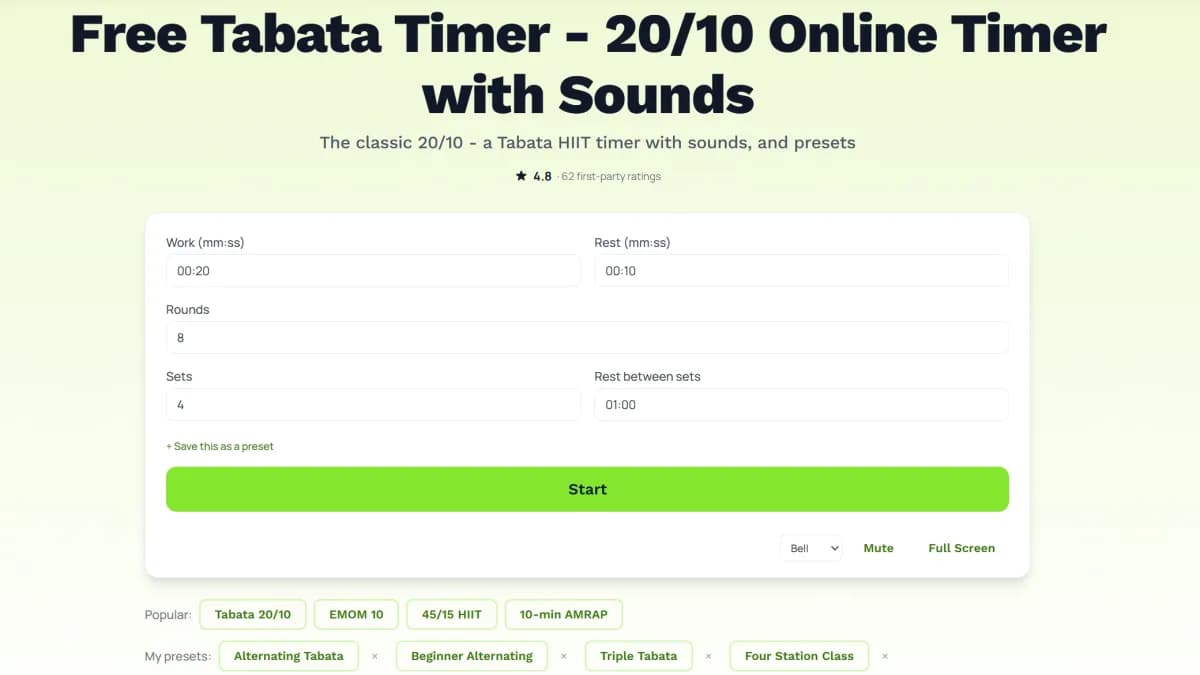
A Tabata workout is four minutes long and most people set it up wrong. The Tabata training set-up that actually works has three parts - the right exercise for maximal effort, the right format (single movement, alternating, or stations), and the right way to stack sets - and this guide covers all three, with 24 Tabata exercises by category and five complete sessions you can launch on the free Tabata timer in one tap.
The structure: 20 on, 10 off, 8 rounds
Every Tabata workout is built from the same block: 20 seconds of maximal work, 10 seconds of rest, eight times - four minutes. That block comes from Dr. Izumi Tabata's 1996 research, and the non-negotiable in the original protocol is maximal:
If round six feels sustainable, you're doing a 20/10 interval workout, not a Tabata Workout/ Tabata training. Both are useful; only one is the protocol. (Full background and the tool itself live on the Tabata timer page; how the format compares to general HIIT and circuits is covered in Tabata vs HIIT vs circuit training.)
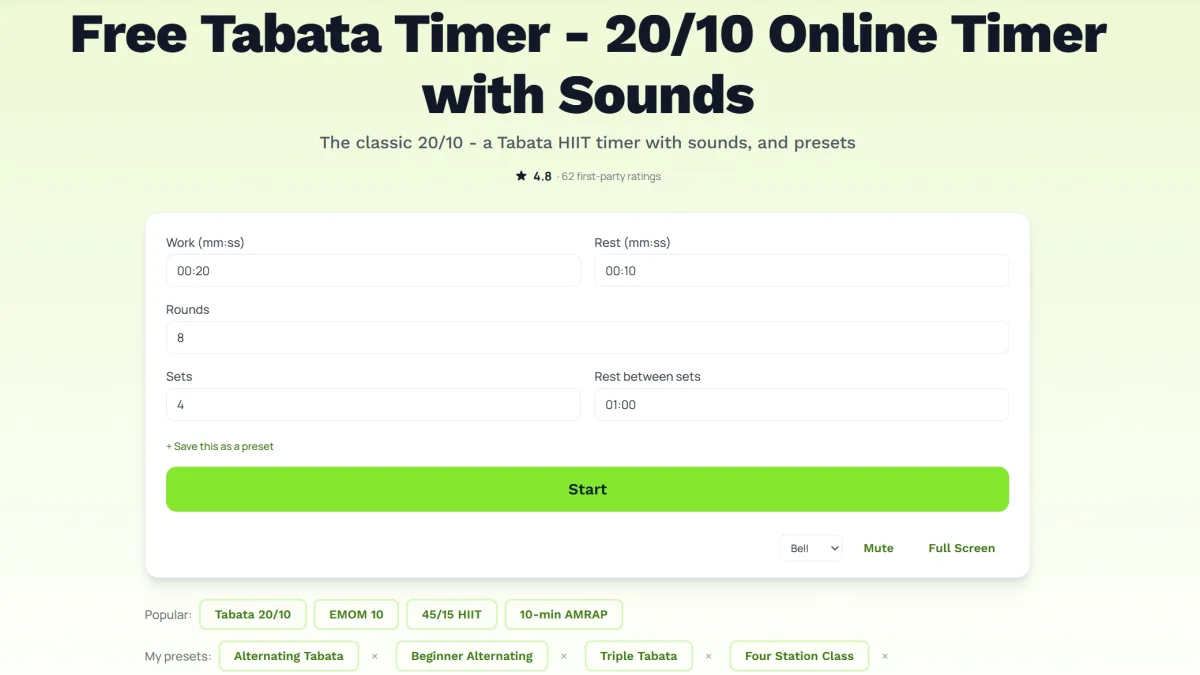
The Tabata training set-up decisions come after the block: which movement, which format, how many blocks, and what surrounds them.
Step 1 - Choose exercises you can do all-out (24 by category)
The best Tabata exercises share two traits:
- Zero setup between rounds, and
- No technical ceiling that collapses at maximal effort.
Heavy barbell lifts fail both tests; the movements below pass.
Machines (the purest Tabata):
- Assault/air bike
- Rower
- SkiErg
- Treadmill sprints (incline)
- Stationary bike
Bodyweight conditioning:
- Burpees ·
- Air squats
- Jump squats
- Mountain climbers
- High knees
- Jumping lunges
- Push-ups
- Plank-to-push-up
Kettlebell / dumbbell:
- Kettlebell swings
- Goblet squats
- Dumbbell thrusters (light)
- DB snatches (alternating)
- Russian twists
Jump rope / plyo:
- Double-unders or fast singles
- Box jumps (low box, step down)
- Lateral hops
Core / carry:
- Hollow rocks
- Bicycle crunches
- Battle ropes
Rule of thumb for the Tabata training set-up: pick a movement where your round-8 output is at least 70% of round-1. If it drops further, the exercise is too technical or too heavy for true 20/10 work. Pick a set of tabata exercises from the list above to build your tabata workout
Tabata exercises to avoid (and what to swap in)
The most common Tabata workout failures come from choosing Tabata exercises that look intense but can't be repeated maximally eight times:
- Barbell snatches and cleans (technique collapses - swap kettlebell swings),
- Muscle-ups and handstand push-ups (skill ceiling - swap push-ups or ring rows),
- Heavy thrusters (load caps output - swap light DB thrusters or air squats)
- Long-transition movements like wall balls from a rack (setup eats the 20 seconds - swap jump squats).
The best Tabata exercises are boring on paper and brutal on the clock; that's the format working as designed, and it's why most Tabata workouts are built around machines, bodyweight, and one kettlebell.
Step 2 - Pick a format
- Single-movement Tabata. One exercise, eight rounds. The original protocol and the hardest version - nowhere to hide. Best for machines and swings. Preset →
- Alternating Tabata. Two movements, odd/even rounds (air squats / burpees). Each movement gets a 40-second recovery between its rounds, so output stays high - the best Tabata training set-up for beginners and for pairing upper/lower. Preset →
- Four-station Tabata. Four movements, two rounds each in sequence - closer to a circuit's variety with Tabata's clock. Great for classes; slightly diluted intensity. Preset ×16 →
- Stacked Tabatas. Multiple complete 4-minute blocks with a 60-second break between - how real sessions are built. Two blocks + break →
Step 3 - Stack, warm up, cool down
A complete Tabata workout session:
- Warm-up (6-8 min): easy movement, then two 20-second ramps at ~80% of the first exercise - the protocol starts at maximal, so you arrive ready.
- Work: 1-4 Tabata blocks. One block for beginners; 2-3 for most; 4 blocks (20 minutes with breaks) is an advanced ceiling, because true maximal output can't be sustained for more.
- Breaks: 60 seconds between blocks (90 for beginners) - enough to reload, not enough to fully recover.
- Cool-down (5 min): walk, breathe, mobilize the movement you just hammered.
Total: 20-35 minutes for a session whose "hard part" is 4-16 minutes. That efficiency is the entire appeal of Tabata training.
5 ready Tabata workouts (one-tap presets)
1. The Original - 4 minutes
Assault bike, single-movement, all-out. Warm up properly; this is the protocol. Start the 20:10 Tabata →
2. Beginner Alternating - 12 minutes
Block 1: air squats / high knees · 90s break · Block 2: push-ups (knees ok) / mountain climbers. Start (2 blocks, 90s break) →
3. Kettlebell Triple - 14 minutes
Swings · goblet squats · alternating DB snatches - one block each, 60s breaks. Start (3 blocks) →
4. Four-Station Class - 16 minutes
Rower · burpees · KB swings · box jumps, two rounds each through twice (×16 continuous). The class-format Tabata workout - run it on a gym screen. Start ×16 →
5. Bodyweight Home - 19 minutes
Jump squats / burpees · jumping lunges / plank-to-push-up · mountain climbers / hollow rocks (alternating blocks), 60s breaks, no equipment. Start (3 blocks) →
Running it for a class? Put the session and the clock on every screen with the Fit Viz workout display - and let FitBeats push the music on the 20s and drop it on the 10s.
Progressing Tabata training over 6 weeks
Progress one variable at a time: weeks 1-2 one block, alternating format; weeks 3-4 two blocks, add one single-movement block; weeks 5-6 three blocks, machines for at least one. Never add blocks and intensity in the same week - if you can add a block, the previous week's blocks weren't maximal. Two Tabata workouts a week is the effective dose for most people; three is the ceiling before recovery bites. Coaches tracking effort with heart rate zones will see a true block sit in the top zone by round four - a useful honesty check on "maximal."
Common Tabata set-up mistakes
Technical movements. Snatches and muscle-ups don't survive round six.
No warm-up. Maximal from cold is how Tabata earned its injury reputation.
Too many blocks. Four is the ceiling; six means the intensity wasn't real.
Skipping the timer. Counting seconds in your head at 90% heart rate doesn't work - use a clock that beeps the switches (here's ours).