Spartan Race: Training and Preparation Guide
Train for a Spartan Race with a proven prep guide for grip strength, unilateral leg durability, and burpee conditioning. Learn how Fit Viz helps gyms run Spartan-style obstacle circuits with on-screen workout displays, built-in station timers, and optional heart rate zones for race-ready pacing.
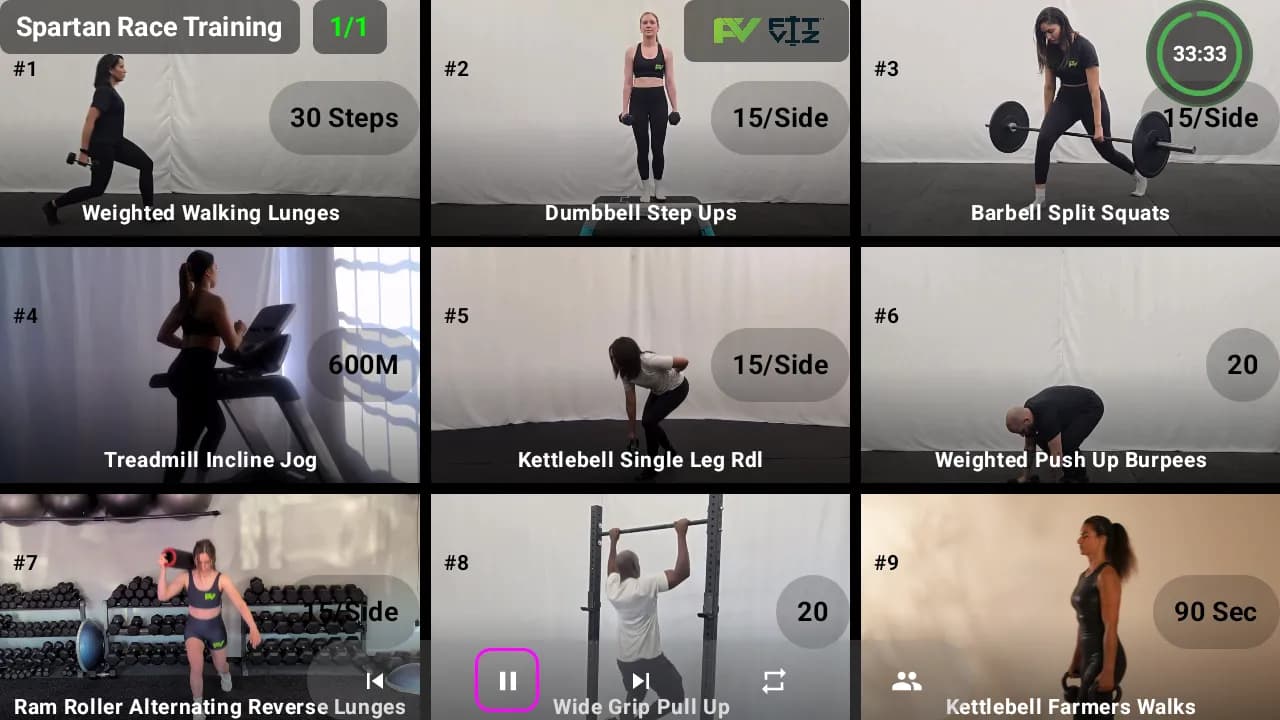
Training for a Spartan Race takes more than gym strength. Spartan is an OCR (obstacle course race) that rewards “functional durability” - the ability to climb, crawl, carry, and keep moving on uneven terrain while your heart rate stays high. The athletes who struggle aren’t always the weakest. They’re often the ones who didn’t train the specific combination of grip fatigue, leg endurance, and penalty-proof conditioning.
In this article, we will expand on:
- Grip strength for rigs, ropes, and carries
- Unilateral strength for hills, descents, and uneven footing
- Burpee conditioning for missed obstacles
- Fit Viz obstacle circuits (workout display + timers + optional heart rate zones) to run Spartan-specific training classes without confusion
What a Spartan Race actually tests
A Spartan Race is not a straight run with a few pull-ups sprinkled in. It’s repeated cycles of:
- Run segments on unpredictable terrain
- Obstacles that spike grip and upper-body fatigue
- Heavy carries that blow up the legs and lungs
- Technical moments where efficiency matters
- Fatigue management so you can keep moving after failures
That’s why Spartan training should be built around durability and repeatability - not just max strength.
Training Focus 1: Grip strength (the Spartan Race limiter)
Grip is the first thing to go on course. When your hands fail, everything slows down:
- You hesitate on obstacles
- You miss more obstacles
- You accumulate more penalties
- You waste energy fighting the implement instead of moving forward
Best grip training for Spartan Race preparation
Build grip across multiple patterns:
1. Hanging endurance
- Bar hangs (dead hang, active hang)
- Towel hangs (more obstacle-like)
- Mixed grips and shoulder engagement
2. Pulling + grip under fatigue
- Pull-ups/chin-ups with controlled tempo
- Ring rows after running intervals
- Rope pulls or rope climbs where possible
3) Carry grip
- Farmer carries (dumbbells/kettlebells)
- Sandbag carries (more race-specific)
- Bucket-style carry practice (awkward load, posture control)
Spartan-specific grip tip
Train grip when you’re already tired. The race rarely asks for a fresh dead hang. It asks for a hang after hills, mud, and carries.
Training Focus 2: Unilateral strength (the hill insurance policy)
Spartan races punish weak single-leg strength. Uneven terrain and climbs force your body into repeated lunges, step-ups, and stabilizing positions.
Why unilateral strength matters
Strong unilateral training improves:
- Climbing efficiency
- Knee and hip stability on descents
- Endurance when one leg is always “doing more”
- Resilience against cramping and breakdown late in the race
Best unilateral movements for Spartan Race training
- Weighted walking lunges
- Step-ups (box or bench)
- Split squats
- Uphill treadmill step-ups (highly transferable)
- Single-leg RDL patterns for stability (optional)
Simple programming principle
For Spartan prep, prioritize unilateral work at moderate volume. The goal is repeatable durability, not a one-rep PR.
Training Focus 3: Burpee conditioning (penalty-proof fitness)
Burpees aren’t just a workout element in Spartan culture - they’re a consequence. A missed obstacle can still cost you burpees, and that penalty shows up when you’re already gassed.
How to train burpees for Spartan Race
Burpee conditioning should build:
- Sustainable rhythm (not sprint-and-die)
- Breathing control under repeated reps
- Quick transitions back to running
Practical formats:
- Burpee intervals after running (compromised conditioning)
- EMOM burpees to train repeatability
- Short sets under fatigue during circuits (more race-like)
Spartan-specific tip
Train “burpees then run.” The penalty isn’t the burpees. It’s what happens after - the forced return to forward movement.
How Fit Viz levels up Spartan Race prep for gyms
Spartan training is hard to run in a class setting because it’s station-based, fatigue-based, and easy to get chaotic. This is where Fit Viz becomes a major advantage for fitness facilities: it turns OCR training into a guided, repeatable class product.
1. Obstacle circuits guided on Workout Displays
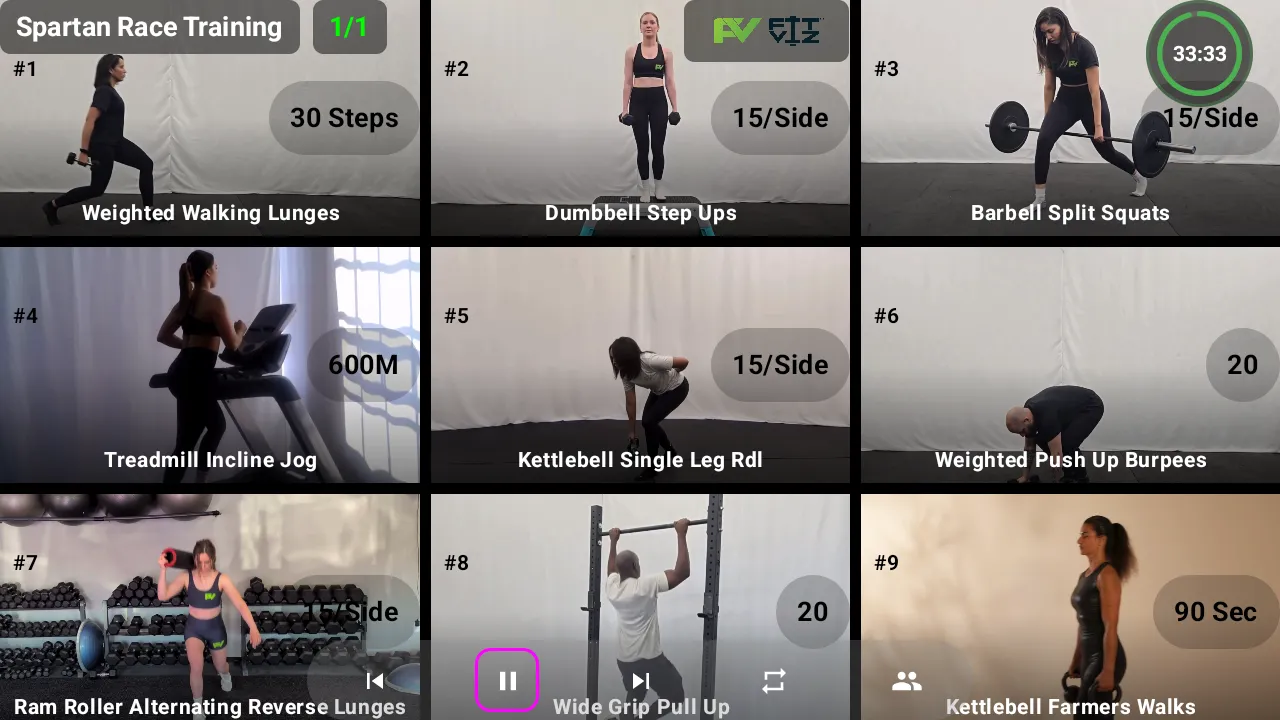
With Fit Viz, gyms can create Obstacle Circuits where the screen tells athletes:
- What to do now
- How long to work
- When to rest and rotate
- What’s next
Example Spartan-style circuit:
- 400m run (treadmill or row equivalent)
- 20 sandbag lunges
- 30–45s pull-up bar hang
- Carry station (farmer carry or sandbag carry)
- Repeat for rounds or timed blocks
Athletes don’t have to remember instructions or wait for shouted cues. The room moves together.
2. Built-in workout timers that run the class
OCR-style training needs structure:
- Station intervals
- Rest windows
- Rotation timing
- Time caps
Fit Viz runs those timers automatically on screen, which is critical for:
- Keeping large groups synchronized
- Preventing early/late rotations
- Letting coaches coach instead of timekeep
3. Visual demonstrations for race-specific movements
Some Spartan-specific movements are easy to do wrong when fatigued:
- Sandbag lunge posture
- Carry bracing and breathing
- Hang mechanics (active vs passive shoulders)
- Burpee efficiency
Fit Viz can display simple visual demos and “form reminders” so athletes self-correct mid-session - reducing coaching repetition and improving safety.
4. Optional: heart rate zones for pacing and durability
Spartan athletes often blow up early. If you train with heart rate guidance, you can coach:
- Sustainable pacing during run segments
- Recovery targets between obstacles
- Safer intensity for mixed-level athletes in one class
Fit Viz can show heart rate zones on screens, making pacing objective and coachable.
A simple weekly Spartan Race training structure (gym-friendly)
If your gym wants to offer Spartan prep as a specialty program, a simple weekly framework works well:
- Day 1: Grip + carries + short compromised run intervals
- Day 2: Unilateral strength + hill simulation (step-ups, treadmill incline)
- Day 3: OCR circuit (run + obstacle stations, timed rotations)
- Day 4: Burpee conditioning + aerobic base (steady run/row)
- Day 5: Race simulation day (longer circuit, fewer stops, strong pacing focus)
Fit Viz helps keep this consistent by displaying the circuit and timing cleanly for every coach and class time.
Conclusion
A Spartan Race rewards athletes who can keep moving under fatigue - through grip-demanding obstacles, unilateral leg endurance on hills, and burpee penalties when things go wrong. The best preparation is specific: grip under fatigue, single-leg durability, and repeatable conditioning.
Fit Viz helps gyms run Spartan-style OCR training as a professional, repeatable class experience. With guided obstacle circuits on workout displays, built-in timers for station flow, and optional heart rate zones for pacing, Fit Viz turns Spartan prep into a scalable training program that members can follow confidently.