HYROX vs CrossFit: Key Differences & Which Is Harder (2026)
HYROX vs CrossFit compared across 12 dimensions - format, cost, skill, community, and which is actually harder - with a decision guide, crossover training, and 2026 numbers.
Updated September 2026 · By Geoffrey - Technology & Operations at Fit Viz
Fit Viz builds software used on both HYROX and CrossFit gym floors - we don't have a side in this one.
The short answer: HYROX is a standardized fitness race - 8 × 1 km runs alternating with 8 fixed stations, identical at every event - while CrossFit is a constantly varied training methodology with competition on top.
The biggest practical difference: HYROX is predictable and pacing-driven with a low skill barrier; CrossFit is unpredictable and skill-driven with a higher learning curve.
Which is harder depends on the axis: HYROX is harder to finish, CrossFit is harder to learn. The full comparison, the numbers, and which one fits you - below.
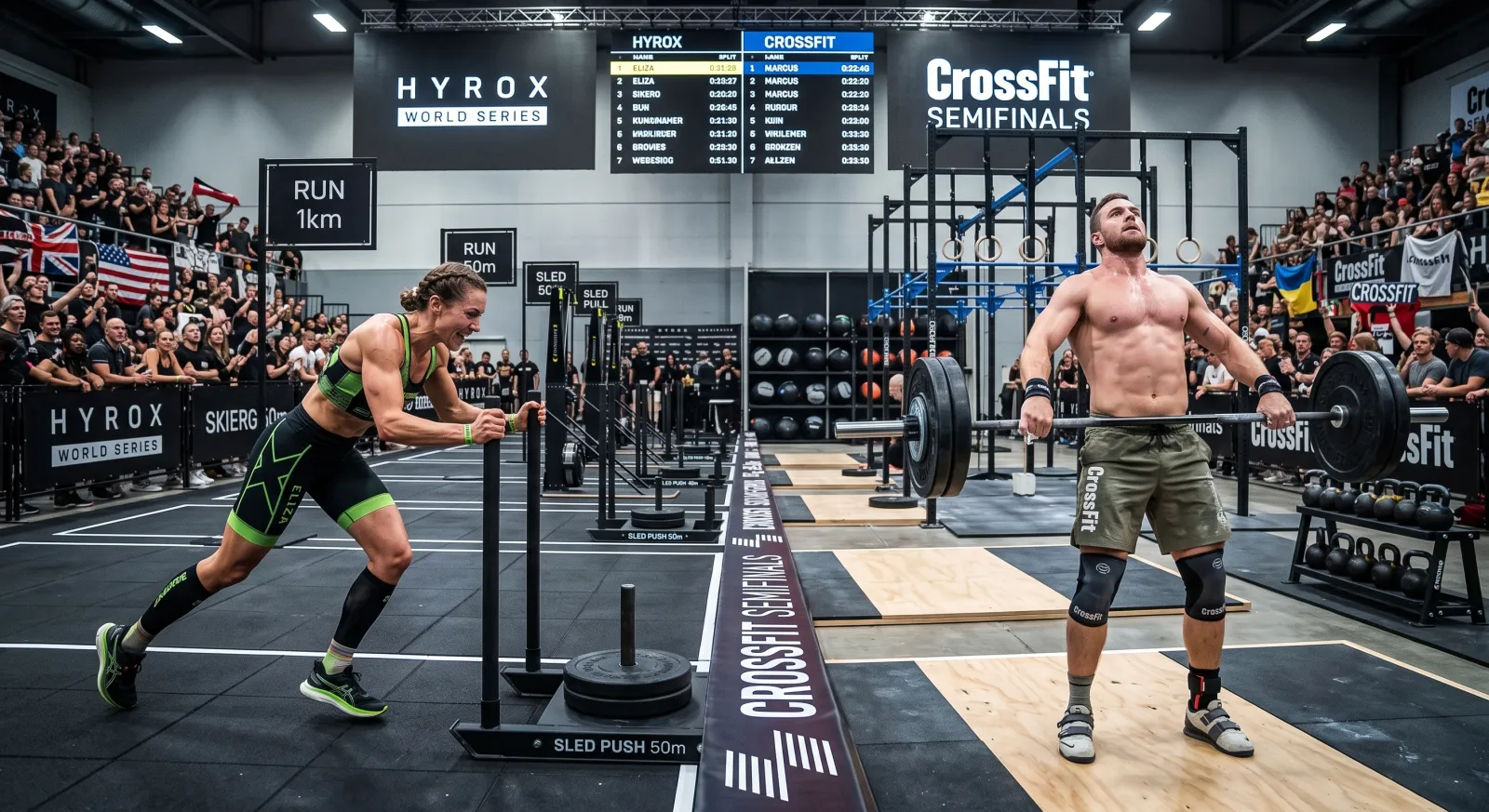
Whether you type it as HYROX vs CrossFit or CrossFit vs HYROX, you're asking the same three questions: what's actually different, which is harder, and which one you should do. This guide answers all three with 2026 numbers, then shows why the smartest athletes increasingly refuse to choose.
HYROX vs CrossFit at a glance
| Dimension | HYROX | CrossFit |
|---|---|---|
| What it is | Standardized indoor fitness race | Training methodology + sport |
| Format | 8 × 1 km run + 8 fixed stations, same worldwide | Constantly varied WODs; competition formats vary |
| Session/race length | 75–110 min typical race (elites < 60) | 10–25 min typical WOD inside a 60-min class |
| Skill barrier | Low - run, push, pull, carry, lunge, throw | High - Olympic lifts, gymnastics, kipping |
| Running | 50–60% of the event (8 km+ total) | Minimal in most WODs |
| Scoring | One time, globally comparable | Varies by workout; leaderboards per WOD |
| Predictability | Total - you know race day exactly | None by design ("unknown and unknowable") |
| Community | Event-weekend + training-club based | Daily box community, tight-knit |
| Typical cost | Race entry ~$120–175; train anywhere | Membership ~$150–250/mo US; Open $20 |
| Injury/load profile | Repetitive endurance load; pacing errors | Technical lifts under fatigue; skill errors |
| Best for | Runners, hybrid athletes, measurable goals | Strength-first athletes, variety seekers, community-first |
| Can beginners start? | Yes - Open/Doubles/Relay divisions | Yes - scaled WODs at a good box |
What is HYROX?
A fixed-format race: run 1 km, do a station, repeat eight times - SkiErg, sled push, sled pull, burpee broad jumps, rowing, farmers carry, sandbag lunges, wall balls, in that order at every event worldwide. Around a million people now race annually across 65 events, the Open-division finish rate is famously high (90%), and average finish times sit around 1:35. Because the format never changes, your time is comparable across every race on earth. Full format, Hyrox weights, and training structure: our HYROX training guide.
What is CrossFit?
A training methodology built on constantly varied functional movement at high intensity, delivered daily in 15,000+ affiliate gyms(as of September 2026) - plus a competitive sport (the Open, semifinals, the Games). No two days are the same by design; the skill ceiling (snatches, muscle-ups, handstand walks) is part of the point. It's as much a community as a program - which is exactly why it retains people the way it does.
How is HYROX different to CrossFit?
Six differences do most of the explaining:
- A race vs a methodology. HYROX is an event you train for; CrossFit is a system you train in. That single distinction drives everything else - HYROX training is specific and periodized toward a date; CrossFit training is general and continuous.
- Predictability. HYROX's format is identical everywhere, so preparation is a pacing-and-fitness problem. CrossFit deliberately keeps workouts unknown, so preparation is a breadth problem. Athletes who love a plan gravitate to HYROX; athletes who love surprise stay CrossFit.
- Running volume. Running is roughly half of a HYROX race - often more of it than many CrossFit athletes do in a month. The compromised running (running on worked legs) is HYROX's signature adaptation. CrossFit runs appear in WODs but endurance running is rarely the centerpiece.
- Skill barrier. Every HYROX movement is learnable in an afternoon; mastering them under fatigue is the challenge. CrossFit's barbell and gymnastics skills take months of coached practice - a higher floor, and for many people a more rewarding ceiling.
- Scoring and comparability. One HYROX time compares globally - your 1:27 means the same in Chicago and Cologne, which is why leaderboards and PR-chasing drive the sport. CrossFit scores are workout-specific; comparability lives inside your box's whiteboard and the annual Open.
- Community shape. CrossFit's community is daily and local - the 6am class knows your name. HYROX's community peaks at events and inside training clubs. Neither is better; they're different social contracts.
Those are the main differences between HYROX and CrossFit in practice. Notice what's not on the list: intensity, effort, or results - both deliver all three. The hyrox vs crossfit decision is about format and temperament, not about which one "works."
Where HYROX and CrossFit are the same
The crossfit vs hyrox framing hides how much the two share - which is exactly why athletes move between them so easily. Both are built on functional movement: squats, pulls, carries, throws, and engines pushed to uncomfortable places. Both are coach-led, class-based, and community-driven in a way that solo gym training never is. Both scale to genuine beginners (scaled WODs on one side; Open, Doubles, and Relay divisions on the other). Both have turned measurable suffering into a social event - the whiteboard and the leaderboard are the same invention wearing different shirts. And both reward the same base qualities: aerobic capacity, strength-endurance, and the stubbornness to keep moving when your legs disagree. The differences are real, but the overlap is why the crossover section below works at all.
Which is harder: HYROX or CrossFit?
The question everyone hedges on. Here's a criteria-based answer:
- HYROX is harder to finish. It's 75–110 minutes of unbroken output where pacing errors compound - go out 20 seconds/km too fast and the wall balls collect the debt. There's no scaling on race day: the sled weighs what it weighs.
- CrossFit is harder to learn. Olympic lifting and gymnastics under fatigue take months of technique work HYROX never asks for. A brand-new athlete can complete a scaled WOD this week; completing a HYROX race takes an 8–12-week build.
Axis by axis, here's how the "which is harder" question actually splits:
| Harder on this axis | Winner | Why |
|---|---|---|
| Finishing the event | HYROX | 75–110 min continuous; no race-day scaling; pacing errors compound |
| Learning the movements | CrossFit | Olympic lifts + gymnastics take months of coached technique |
| Week-one accessibility | CrossFit is easier | Every WOD scales; HYROX race weights don't |
| Mental grind | HYROX | The 6th kilometre with wall balls waiting is a negotiation |
| Skill ceiling | CrossFit | Muscle-ups and snatches have no HYROX equivalent |
| Training-plan discipline | HYROX | Specific, periodized prep toward a fixed date |
So: is CrossFit harder than HYROX? For a beginner walking in the door, CrossFit is harder to do well and HYROX is harder to survive. Independent comparison work - including performance-study coverage in Men's Health [ read + the actual study findings below] - lands the same way: they stress different systems (sustained aerobic output vs mixed-modal power and skill), so "harder" depends on which system you're weakest in. Most honest answer we've seen from athletes who do both: whichever one you didn't train for.
The primary research cited by Men's Health regarding the physiological differences between HYROX and CrossFit stems from pioneering peer-reviewed data led by researchers like Dr. Tom Brandt (University of the Bundeswehr Munich) alongside insights from sports scientists like exercise physiologist Dr. Tim D’Hulst.
Rather than viewing them as identical functional fitness disciplines, the research highlights how they tax fundamentally different metabolic energy pathways.
The Study Findings: HYROX vs. CrossFit
| Feature / Metric | HYROX Findings | CrossFit Findings |
|---|---|---|
| Primary Energy System | Oxidative Phosphorylation (Pure Aerobic Base & Endurance) | Glycolysis & Creatine Phosphate (Anaerobic Power & Explosiveness) |
| Race/Workout Composition | 60% of total time is spent running | Highly varied; heavy emphasis on vertical, max-force lifting & gymnastics |
| Sustained Intensity | >99% of the event is spent at "hard" to "very hard" effort (>80% Max HR) | Intermittent cardiac spikes with brief, high-output recovery windows |
| Average Completion Time | 60 to 90 minutes of continuous movement | 3 to 20 minutes for typical benchmark MetCons |
| Key Performance Predictor | Maximal Oxygen Consumption (VO₂ max) & Running Economy | Total Body Strength & Peak Power Output |
Key Scientific Takeaways
- The "Endurance Costume" Concept: Peer-reviewed data led scientists to label HYROX as "an endurance sport wearing a functional fitness costume." While it features heavy functional exercises (like sled pushes and lunges), at race pace, these stations operate as aerobic, localized muscle-fatigue challenges rather than maximal strength tests.
- The Lactate Curve Disconnect: In testing elite functional athletes, Dr. D'Hulst noted a distinct metabolic divergence. CrossFit athletes heavily utilize the anaerobic pathway (sitting on the left side of the lactate curve), leading to massive power but a surprisingly lower pure aerobic base. HYROX forces the athlete to the right side of the curve, requiring sustained fat and glucose oxidation over a long, continuous duration.
- Running Economy Degradation: Separate testing on biomechanical fatigue found that CrossFit-style anaerobic exhaustion compromises running posture and economy more severely (showing up to a 12.5% drop in running efficiency post-workout) compared to HYROX-trained athletes, who maintained far better pacing and oxygen extraction under localized load.
Ultimately, the research published and reported on by Men's Health shows that transferring from CrossFit to HYROX yields strong structural station performance, but true HYROX speed can only be unlocked by building a broad, steady aerobic engine.
HYROX vs CrossFit: cost
| Cost item | HYROX | CrossFit |
|---|---|---|
| Event entry | $120–220 per race | $20 to $35 Per class or $50 to $150 for local competitions |
| Training | Any gym works; HYROX-ready gym/class recommended | Crossfit Affiliated Gym Membership ~$150–250/mo US |
| Equipment dependence | Sleds/ergs needed for full prep | Full barbell + gymnastics setup (the box provides) |
| For gym owners | HYROX Training Club license $130/mo | CrossFit affiliate fee ~$4,500/yr |
Net: CrossFit costs more monthly but includes daily coaching; HYROX costs per race and lets you train anywhere - cheapest of all if your gym already runs HYROX classes.
Which should you choose?
Choose HYROX if you like running, want a measurable goal with a date on it, prefer knowing exactly what you're training for, or you're a hybrid athlete who wants one number to beat.
Choose CrossFit if you want strength and skill development, thrive on variety, value a daily coached community, or find repetitive endurance work soul-flattening.
Choose both if you're greedy - see below, because they stack better than the rivalry suggests.
A quick gut-check that settles most crossfit vs hyrox decisions: picture your ideal Saturday. If it's a race bib, a start corral, and a time to beat - HYROX. If it's a partner WOD, a barbell, and coffee with the 9am class after - CrossFit. If the honest answer is "both, alternating" - congratulations, you're a hybrid athlete, and the difference between the two just became your training calendar rather than a decision.
Can you do both? (Yes - and the crossover is the fun part)
The elite field already answered this: CrossFit Games athletes - Tia-Clair Toomey-Orr among them - have crossed over and immediately contended at HYROX. The training systems complement each other: CrossFit builds the strength-endurance and engine that stations demand; HYROX builds the aerobic base and pacing discipline most CrossFit athletes lack.
A working hybrid week looks like:
- 2–3 CrossFit classes (strength + mixed-modal),
- 2 runs (one easy, one tempo),
and - One HYROX-style compromised session (run/station pairs - hyrox stations examples here).
Eight weeks out from a race, tilt toward HYROX-specific training;
Between races, live in the box.
Transitioning from CrossFit to your first HYROX? Your stations are ahead of the field and your running is behind it - flip your volume accordingly: most box athletes need 8 weeks of genuine run volume more than they need another sled session.
Going the other way - HYROX athlete joining a box? Spend your first month on barbell technique at light loads and let intensity wait; the engine you built racing will carry you through WODs while the skills catch up.
Will HYROX replace CrossFit?
No - and the data doesn't suggest it's trying to. HYROX has grown to roughly a million annual participants and 15,000 affiliated training clubs while CrossFit holds roughly 10,000 affiliates worldwide; both grew last year.
They increasingly feed each other: boxes add HYROX-style classes to retain endurance-minded members, and HYROX athletes join boxes for strength. CrossFit's own editorial calls HYROX a complementary "testing ground" - the rivalry is mostly a search query.
For gym owners: you don't have to pick either
Fit Viz sits on both sides of this comparison daily - the same platform runs WOD programming, whiteboards, and benchmark tracking for CrossFit affiliates and station-flow displays, rotation timers, and race simulations for HYROX training.
If your box is adding HYROX classes (or your HYROX club is adding strength blocks), the floor tech is one system, not two: See
The Hyrox vs crossfit question inside a facility isn't either/or - hybrid programming is the fastest-growing class type we see on member schedules, and it retains both tribes.
FAQ
Is CrossFit harder than HYROX?
Harder to learn, yes - the skill barrier (Olympic lifts, gymnastics) is much higher. HYROX is harder to finish: 75–110 minutes of pacing-critical endurance with no race-day scaling. Train for the one that scares you less, then borrow from the other.
What are the pros and cons of HYROX?
Pros: globally comparable times, low skill barrier, total predictability, a concrete goal, beginner divisions (Doubles/Relay). Cons: repetitive by design, running-heavy for strength-first athletes, per-race entry costs, and full prep needs sled access.
Will HYROX replace CrossFit?
No. Both grew this year; they serve different appetites (race-day measurability vs daily varied community) and increasingly share athletes and even gyms.
Which is better for fat loss, CrossFit or HYROX?
The one you'll do consistently. HYROX training's long aerobic sessions burn more per session (a race can run 600–1,000+ kcal);
Hyrox Calorie Burn Breakdown(calories people burn on average with hyrox training/races/events)
- Standard Race or Simulation (75–105 minutes): Most recreational athletes burn between 1,000 and 1,300 calories.
- Faster / Lighter Athletes (60–75 minutes): Lighter competitors or elite racers moving quickly through the course typically burn around 800 to 1,000 calories.
- Slower / Heavier Athletes (90+ minutes): Heavier individuals or those taking longer to finish face a higher total energy cost, often burning 1,300 to 1,500+ calories due to the prolonged time under tension and movement.
- Shorter Training Sessions (45–60 minutes): Standard high-intensity interval training (HIIT) or station-focused practice sessions generally burn 400 to 800 calories, depending on your heart rate and body weight.
CrossFit's intensity and strength work protect muscle and metabolic rate. Adherence beats modality.
Is HYROX the same as CrossFit?
No. HYROX is a standardized race (8 runs + 8 fixed stations); CrossFit is a varied training methodology and sport. The overlap is functional movement and suffering - the difference is predictability, skill barrier, and how each keeps score.
Can beginners do HYROX or CrossFit?
Both. HYROX offers Open, Doubles, and Relay divisions with achievable weights; good CrossFit boxes scale every WOD. First HYROX: give yourself 8–12 weeks; first CrossFit class: just book it.
Keep reading: