Tabata vs HIIT vs Circuit Training: The Differences, and Which One to Use
Tabata vs HIIT vs circuit training compared: structure, work-to-rest, intensity, duration, heart rate zones, and which format fits your goal - with timers for all three.
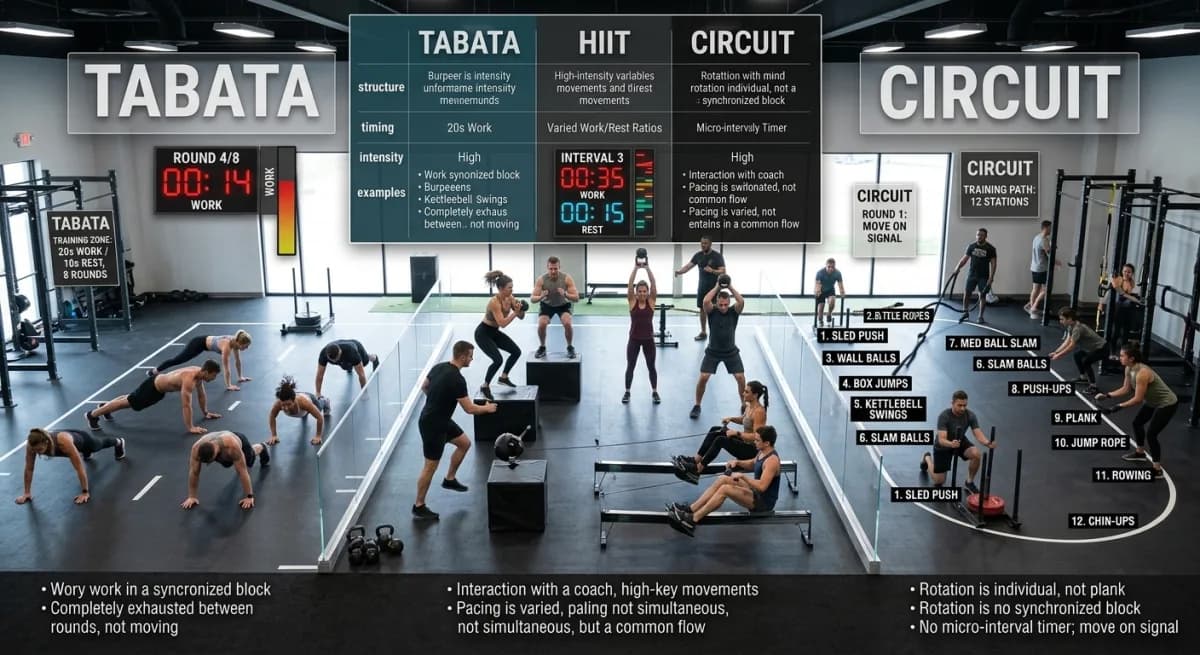
Tabata vs HIIT is the most-searched fitness comparison that has a one-sentence answer - Tabata is a specific HIIT protocol - and a much longer useful one. Add circuit training, which gets lumped in with both, and the three formats differ in structure, intensity, duration, and what they're actually for. Here's the full comparison, plus a timer for each.
The one-paragraph answer
Tabata is 20 seconds of maximal work, 10 seconds of rest, 8 rounds - a fixed 4-minute prescription. HIIT (high-intensity interval training) is the umbrella: any alternation of hard work and recovery - 30/30, 40/20, 1:2, 4×4 minutes - Tabata is one point inside it. Circuit training is a sequence of stations performed one after another with minimal rest, usually at moderate intensity, emphasizing variety and volume over maximal output. So in HIIT vs Tabata, Tabata is the strictest, shortest, hardest child; in Tabata vs circuit training, they're different species - one is a sprint protocol, one is a strength-endurance format.
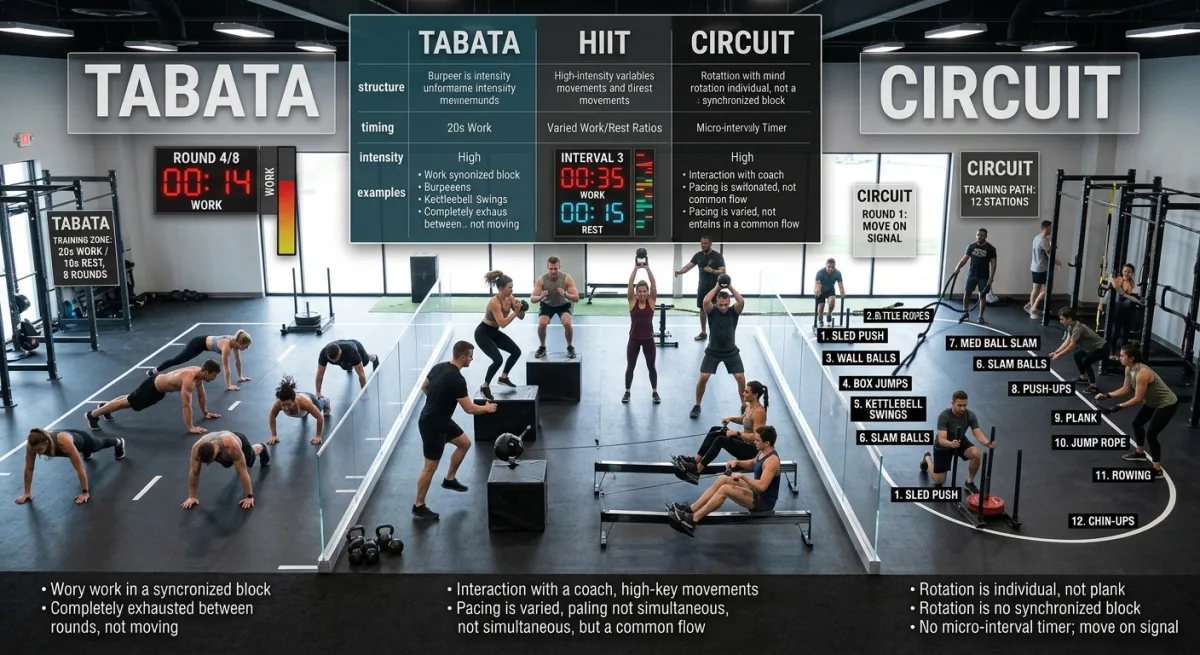
Side-by-side comparison
| Tabata | HIIT | Circuit training | |
|---|---|---|---|
| Structure | 20s work / 10s rest × 8 | Any hard/easy intervals | 6-12 stations in sequence |
| Work:rest | Fixed 2:1 | Flexible (1:1, 1:2, 2:1…) | Continuous or ~15s transitions |
| Intensity | Maximal (170% VO₂max in the original study) | High, sub-maximal to near-max | Moderate |
| Block length | 4 minutes | 10-30 minutes | 20-45 minutes |
| Typical heart rate zone | Zone 5 by round 4 | Zones 4-5 in work, 2-3 in rest | Zones 3-4 throughout |
| Primary adaptation | Anaerobic + aerobic power | Aerobic capacity, fat loss, conditioning | Muscular endurance, general fitness |
| Best for | Trained athletes, time-poor conditioning | Most people, most goals | Beginners, groups, strength-endurance |
| Equipment | One movement, ideally a machine | Anything | Multiple stations |
| Timer | Tabata timer | Interval timer | EMOM / station timer |
Tabata vs HIIT
Every Tabata is HIIT; almost no HIIT is Tabata. The difference is prescription and intensity:
HIIT lets you choose ratios and effort levels, which is why it's the right default for most people - a 30/30 at 85% for 15 minutes is HIIT, sustainable, and effective.
Tabata removes the choices and demands maximal effort, which makes it brutally efficient and easy to do wrong.
If you can complete four Tabata blocks comfortably, you did HIIT and called it Tabata. Neither is "better" - Tabata is HIIT with the dials welded at maximum.
Tabata vs circuit training
This is the comparison people mean when they ask whether Tabata "counts" as a full workout.
A circuit builds strength-endurance across 6-12 movements at a pace you can hold for 30 minutes; Tabata builds power and conditioning in four minutes you can't hold at all.
Circuits are volume; Tabata is intensity. A Tabata vs circuit training decision is really a goal decision:
- General fitness and muscle endurance → circuit;
- Conditioning ceiling in minimal time → Tabata.
HIIT vs circuit training
The blurriest line: A fast circuit with short rests drifts into HIIT territory, and a HIIT session with multiple movements looks like a circuit.
The tell is intensity: Circuits sit in heart rate zones 3-4 continuously; HIIT swings between zone 5 work and zone 2-3 recovery.
Same movements, different physiology. Gyms displaying live heart rate zones can watch a class drift from one to the other in real time.
Which should you use? (by goal)
- Fat loss / general conditioning: HIIT - the most flexible, most sustainable dose. (see the HIIT Intervals Chart Guide)
- Time-poor, already fit: Tabata - the most work per minute that exists.
- Beginner or returning: Circuit training first, HIIT second, Tabata later.
- Muscular endurance / group classes: circuits (or four-station Tabata as a bridge - see the Tabata set-up guide).
- Athletes building a top-end engine: Tabata blocks inside a HIIT-and-strength week.
Can you combine them? A sample week
Yes - most good programs use all three:
- Monday: Strength + a 20-minute HIIT finisher.
- Wednesday: 30-minute circuit.
- Friday: Strength + 2 Tabata blocks.
- Weekend: Easy aerobic work.
The formats stack because they load different systems - the mistake is running three maximal Tabata days and calling it variety.
Coaching all three? One workout timer hub runs Tabata, custom HIIT intervals, and station rotations; the Fit Viz workout display puts the format, the clock, and live zones on every screen.
Three Tabata vs HIIT misconceptions
"Tabata is just a shorter HIIT." The Tabata vs HIIT difference is intensity, not length. A 4-minute HIIT block at 85% is short; a Tabata block at true maximal effort is a different physiological event - the original study measured ~170% of VO₂max, which is why four minutes was enough and why most "Tabata" classes are actually HIIT.
"Circuits are low-intensity HIIT." Circuit training isn't HIIT with worse marketing - it's a strength-endurance format that deliberately avoids maximal output so you can complete 8-12 stations with quality. Making it harder makes it HIIT; making it heavier makes it strength work; neither makes it a better circuit.
"Pick one and stick with it." The Tabata vs HIIT vs circuit question isn't a tournament. Well-built programs use all three across a week for different adaptations - the sample schedule above shows how.